A quotation for “5M,” “7M” or “11M” belts can describe a synchronous tooth-pitch family, a reel, or a supplied belt length—not a direct alternative to a conventional V-belt. By separating those meanings, matching the belt to its pulley and checking the drive’s operating demands, you can choose the correct replacement and compare Chennai suppliers without comparing unlike products.
Key takeaways
- 5M, 7M and 11M identify tooth pitch, not belt length.
- Choose a V-belt for friction drive; choose synchronous belts for timed motion.
- Match belt profile, pitch length, tooth count and pulley dimensions.
- Ask suppliers for belt markings, material details, stock condition and replacement guidance.
Are 5M, 7M and 11M belts actually five, seven or eleven metres long?
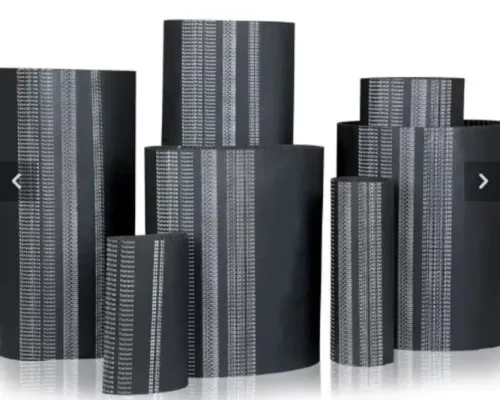
5M normally means a 5 mm tooth pitch, not a five-metre belt. A 5M-JB belt has teeth spaced 5 mm apart, so its pitch length depends on tooth count.
Treat 7M and 11M listings cautiously: confirm the tooth profile and applicable standard rather than assuming they belong to the common 5M, 8M or 14M timing-belt families.
| Drive type | Engagement and behaviour | Main trade-off |
|---|---|---|
| V-belt | Wedge action in a grooved pulley; controlled slip under overload | Tolerates shock and overload, but slip creates heat, vibration and speed-ratio error |
| Synchronous belt | Teeth positively engage a matching toothed pulley; normal slip is avoided | Delivers accurate ratio and lower speed variation, but overload can cause tooth jumping or tooth shear |
| Noise and vibration | V-belts can squeal when loose; toothed belts can transmit tooth-mesh noise | Alignment, tension and pulley condition affect both |
A belt marked by tooth pitch must be ordered with a matching toothed pulley. It cannot run on an existing V-belt pulley, so converting the drive requires compatible pulley pitch, profile, tooth count and width.
A Chennai listing using “5 m,” “7 m” or “11 m” can mean approximately 5,000 mm, 7,000 mm or 11,000 mm of belt, a reel, or a supplied cut length. In a v belt comparison, ask whether the quoted measurement is inside, datum, pitch, outside or supplied cut length.
That distinction prevents the search phrase “v belts or 5m 7m 11m belts in chennai” from comparing unlike products.
When should a Chennai drive use a V-belt instead of a synchronous belt?
Use a conventional V-belt when controlled slip under overload, economical power transmission and tolerance of intermittent shock matter more than exact ratio control. Choose a synchronous belt when positive engagement, repeatable ratio and positioning accuracy matter; it needs matching toothed pulleys.
| Drive factor | Conventional V-belt | Synchronous belt |
|---|---|---|
| Speed and torque | Suits moderate-to-high torque where brief slip is acceptable | Suits controlled speed and torque, within tooth-load limits |
| Driver/driven rpm and ratio | Ratio changes slightly with slip and wear | Maintains the selected ratio without steady-state slip |
| Pulley diameter and wrap | Needs adequate small-pulley diameter and wrap to prevent heat and slip | Needs compatible tooth count, pitch and minimum pulley diameter |
| Centre distance and space | Flexible for longer centres and common industrial layouts | Requires space for toothed pulleys, tensioning and precise alignment |
| Starting load and overload | Wedge action tolerates intermittent shock; slip can protect the driven machine | Overload can cause tooth jump or tooth shear, stopping a spindle or damaging a machine-tool auxiliary drive |
For a V-belt drive comparison, collect these inputs before selecting industrial V-belt sizes:
- Transmitted power, service factor, small-pulley diameter, driver and driven rpm, speed ratio, shaft arrangement, centre distance, wrap angle, operating hours and load pattern.
- Check oil, coolant, abrasive dust, moisture, ozone, temperature and static-electricity requirements. “Industrial rubber” does not prove oil resistance or antistatic performance.
- Motor kW alone is insufficient: it does not describe starting load, shock duty or bending severity at the small pulley.
How do you read V-belt sizes, tooth counts and replacement markings?
Read the section before reading the length: industrial V-belt sizes use a profile code, while synchronous belts use tooth pitch and tooth count. The classical sections are approximately:
| Section | Nominal cross-section |
|---|---|
| Z | 10×6 mm |
| A | 13×8 mm |
| B | 17×11 mm |
| C | 22×14 mm |
| D | 32×19 mm |
SPZ, SPA, SPB and SPC are narrow or wedge sections, not interchangeable with Z, A, B, C or D. Match both section width and height to the pulley groove; the correct length with the wrong section will ride high, bottom out or slip.
1. For a synchronous belt, calculate pitch length as tooth count multiplied by tooth pitch. A 100-tooth 5M belt has a 500 mm pitch length. Record tooth pitch, tooth count, belt width, belt length and tooth profile; confirm unusual 7M or 11M profiles with the supplier.
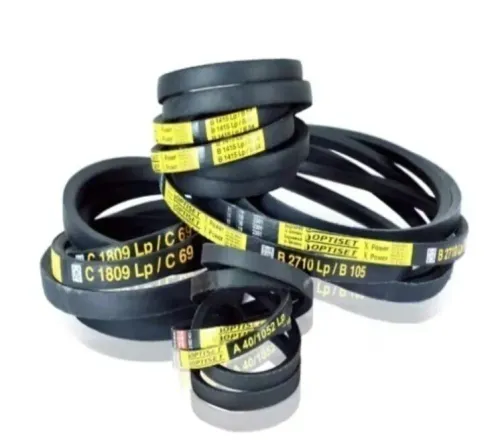
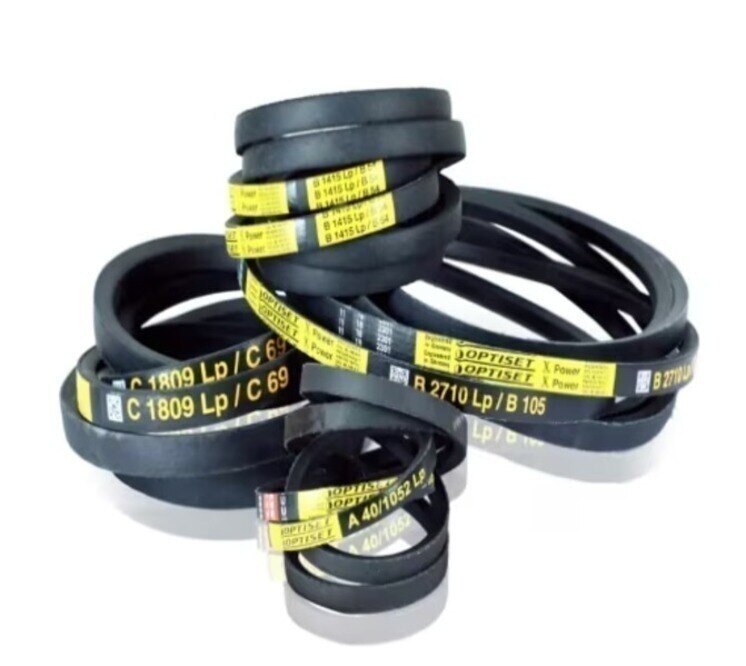
2. For a V-belt, record the marking and ask whether its length is datum, pitch, inside or outside length. These codes are not universally interchangeable across V-belt manufacturers in India, so do not convert one directly without the stated standard.
3. Compare the faded belt with the machine manual and measured pulley data. For a multi-belt drive, request a matched set from one product family rather than mixing individual belts. Include the complete marking, quantity and pulley measurements in the quotation request.
What pulley and installation checks prevent an apparently wrong belt?
A replacement belt is compatible only when its belt geometry and pulley geometry agree. Start with the pulleys, not the belt.
| Drive type | Pulley checks | Installation checks |
|---|---|---|
| V-belt | Groove angle and profile, groove count, wear, glazing, burrs, bore, keyway and minimum pulley diameter | Shaft parallelism, angular alignment, correct seating and manufacturer-specified tension |
| Synchronous belt | Tooth pitch and profile, tooth count, pulley width, bore, keyway and minimum pulley diameter | Compatible toothed pulleys, correct tooth engagement, alignment and specified tooth tension |
A V-belt drive comparison must include the pulley’s condition: polished grooves let a belt ride too deeply or too high, while an incorrect angle cannot be fixed by adding tension.
Industrial V-belt sizes such as A, B, C, D, SPZ, SPA, SPB and SPC each require their matching groove; never substitute a synchronous belt onto V-belt pulleys. Changing drive type requires compatible toothed pulleys, not merely a different belt.
Set centre distance within the adjustment range, align pulley faces and shafts, then seat every belt fully in its groove without levering it over a flange. Measure tension using the belt manufacturer’s force-deflection, frequency or gauge method.
After run-in, inspect the drive and retension only when the specification calls for it. Squeal and heat indicate slip or under-tension; bearing load and rapid wear indicate over-tension. Edge wear indicates misalignment, oil-soaked rubber requires removal and contamination control, and tooth marks or sudden ratio loss indicate jumping or tooth damage.
Replace a complete matched V-belt set when pulley wear exists or belt lengths differ.
What should you ask a Chennai belt supplier before comparing prices?
A useful RFQ begins by identifying the product family, not by asking for a price per metre. State whether you need a V-belt section and length, or a synchronous belt tooth-pitch family such as 5M, 7M or 11M.
1. Record the belt width, exact length convention—inside, datum, pitch, outside or supplied cut length—and construction, such as rubber, polyurethane, wrapped or raw-edge. Add the quantity and replacement urgency.
2. Provide operating rpm, transmitted power, driver and driven pulley diameters, centre distance, shaft arrangement, wrap angle, and the number of V-grooves or synchronous-belt teeth. Motor kW alone does not describe the load.
3. Describe ambient conditions, including oil, coolant, abrasive dust, moisture, ozone, temperature and static-electricity requirements. State the load pattern and starting shocks so the supplier can apply the correct service factor.
4. Ask the quotation to confirm groove or tooth compatibility, minimum pulley diameter, belt width, matched-set supply where required, batch traceability and conformity documentation. For multiple V-belts, request one matched set rather than mixed individual belts.
Do not compare quotations based only on “metres.” A 5M tooth-pitch belt, a 5,000 mm cut length and a V-belt length code describe different products. V-belt manufacturers in India may use different length conventions, so record the measurement system beside every price.
Jigna Sales Corporation is one Chennai supplier to consult, but recorded drive data and verified compatibility—not location or the lowest price—should decide the purchase.
Related products
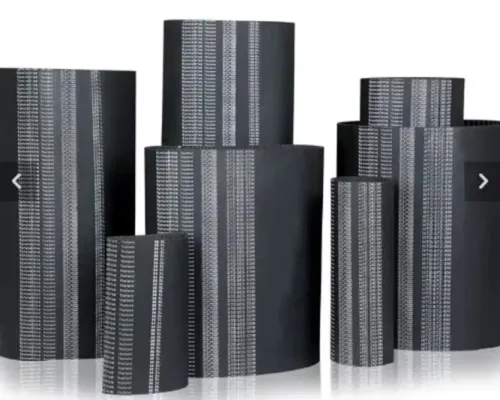
 | 5m, 7m, 11m Belts Belts are recommended for use on bench type milling machines, lathe drives, woodworking and metalworking machine spindle drives, computer peripheral... View product → |
 | V-Belt V-Belt V-belts are widely used on high speed and high torque drives on light, heavy industrial and automotive machines. |
Frequently asked questions
Are 5M, 7M and 11M belts five, seven or eleven metres long?
No. The numbers normally identify tooth pitch: 5 mm, 7 mm or 11 mm. Belt length depends on tooth count and pitch.
When should a Chennai drive use a V-belt instead of a synchronous belt?
Use a V-belt for smooth friction transmission, shock absorption and cost-effective general drives. Use a synchronous belt when timing, positive engagement or slip-free indexing matters.
How do you read V-belt sizes, tooth counts and replacement markings?
Read the belt profile, nominal length, pitch length or datum length, tooth pitch and tooth count from the marking. Confirm the marking system before comparing replacements.
What pulley and installation checks prevent an apparently wrong belt?
Check pulley profile, pitch, groove or tooth dimensions, alignment, centre distance, shaft condition, tension and the belt’s seating before rejecting a replacement.
What should you ask a Chennai belt supplier before comparing prices?
Request the exact belt code, dimensions, tooth count or length, compound and reinforcement details, manufacturer, batch information, warranty terms and stock condition.