A poly V belt is a friction-drive belt with several longitudinal ribs, but choosing one involves more than matching its length and rib count. You will learn how to identify its profile, compare it with other drive types, recognise unsuitable applications, and specify the belt and pulleys correctly.
Key takeaways
- Read belt length, rib count, profile, and construction markings before ordering.
- Choose a poly V belt for serpentine routing, compact drives, and multiple pulley contacts.
- Avoid poly V belts when precise tooth timing or heavy shock loads controls the design.
- Match pulley grooves, tension, alignment, and installation tools to extend belt life.
What a Poly V Belt Is and What Its Markings Mean
A poly V belt is a continuous belt with multiple longitudinal, V-shaped ribs on one face. The ribs run in matching pulley grooves, so friction at several rib-and-groove contacts transmits power. What is a poly V belt in practical terms? It is also called a multi-ribbed, serpentine, or V-ribbed belt—not a toothed timing belt.
“Poly” describes the multiple-ribbed form, not automatically polyurethane. Rubber ribbed belts and polyurethane ribbed belts are different constructions; do not treat “poly” as a material specification. The poly belt meaning is therefore a ribbed power-transmission design.
- Ribs: raised V sections that contact the pulley flanks.
- Grooves: matching channels whose pitch and shape must fit the ribs.
- Backing: the layer behind the ribs; a smooth back can run on an approved flat idler.
- Tensile members: embedded cords that carry the belt’s tension.
- Belt pitch or section: rib spacing and the profile designation used to match belt and pulley.
The ISO 9982 family includes these common profiles:
| Profile | Approximate pitch |
|---|---|
| PJ | 2.34 mm |
| PK | 3.56 mm |
| PL | 4.70 mm |
| PM | 9.40 mm |
A marking such as 6PK1230 generally means six ribs, PK profile, and a nominal length of about 1,230 mm. Confirm whether that length is effective, datum, or pitch length; numbers from different belt families are not automatically interchangeable.
When a Poly V Belt Drive Fits Better Than Other Belt Types
Choose a poly V belt drive when space is tight, one belt must follow a serpentine route, or several accessories must run from one continuous belt. Its multiple ribs share frictional contact across matching grooves, giving more flexibility than a single wedge while fitting small pulleys and high rotational speeds.
| Option | Contact and construction | Best fit |
|---|---|---|
| Single V-belt | One wedge-shaped belt section grips one groove by friction | Separate drives with available space and moderate routing complexity |
| Banded V-belt | Several V-belts joined by a common band | Heavy, shock-loaded drives where belt whip and matching are concerns |
| Flat belt | Broad, flat friction contact | Long centres, large pulleys, and layouts suited to straight running |
| Poly V belt | Several longitudinal ribs flex around multiple grooved pulleys | Compact serpentine drives, multiple accessories, high speed, and small pulley diameters |
| Chain | Rollers and teeth provide positive engagement rather than friction | Applications where slip is unacceptable and chain maintenance is available |
A poly V belt can turn around several pulleys, but rib count alone does not establish power capacity. Check the profile, belt construction, speed, smallest pulley diameter, belt length, installation tension, wrap angle on that pulley, temperature, and required power.
Choose a conventional or banded V-belt when pulley availability, high load capacity, long centre distance, or heavy shock loading outweighs compactness. Choose a flat belt when broad contact and long-span flexibility matter.
Choose a chain when slip could damage the machine or process; a poly V belt’s friction drive can slip under overload or low tension, while failure can stop every accessory it serves.
Also confirm installation access: a continuous serpentine belt may be efficient, but replacing it requires a route that can be released and fitted without forcing it.
When a Poly V Belt Is the Wrong Drive Choice
Reject a poly V belt when slip, stretch, or belt failure would disrupt the machine. A poly V belt drive transmits torque through friction between rib flanks and pulley grooves, so it can slip when overloaded, under-tensioned, contaminated, or poorly wrapped.
Choose a synchronous or timing belt when the application requires:
- Exact shaft synchronisation
- Indexing or phasing
- Zero-slip positioning
- A guaranteed speed ratio
A timing belt is not simply a quieter poly V belt. Its teeth engage matching pulley teeth, preventing ordinary frictional slip but introducing tooth-jump, tooth-shear, and pitch-mismatch risks. It also demands correct tooth profile, pulley alignment, tension, and contamination control.
Reject the poly V belt and reassess the drive when you have:
- Severe shock loading or reversing torque
- A very long centre distance that exceeds the belt’s stable span and tensioning limits
- Load beyond the calculated belt capacity
- Excessive angular or parallel misalignment
- Insufficient wrap on the smallest pulley
- Oil, fuel, solvent, coolant, or cleaning-chemical exposure outside the belt compound’s rating
A conventional single V-belt, a banded V-belt arrangement, chain, gear drive, or another transmission may suit heavy loads, shock, long centres, or slip-intolerant service better. Base that choice on power, speed, wrap, pulley geometry, tensioning, and failure consequences—not rib count alone.
Do not apply belt dressing to contaminated ribs; correct the leak or chemical exposure and inspect the pulleys.
How Pulley Geometry, Tension, and Installation Decide Service Life
A pulley below the manufacturer’s minimum diameter can destroy a poly V belt even when its length and rib count are correct. Repeated bending fatigues tensile members, cracks ribs, generates heat, and can separate the belt.
1. Check the manufacturer’s rating table for the exact PJ, PK, PL, or PM profile and belt construction. Do not infer the minimum diameter from rib count. Confirm that every pulley, including any backside idler, falls within the permitted diameter and idler-direction limits.
2. Set tension to the calculated drive value or the equipment manufacturer’s procedure, including any specified allowance for initial seating. Under-tension causes slip, glazing, squeal, heat, and rib wear; over-tension increases shaft and bearing loads without improving transmission.
3. Inspect every pulley before fitting the replacement. Worn, rusted, contaminated, or incorrectly profiled grooves cause slip and heat, while angular or parallel misalignment produces uneven wear, tracking, and thrown ribs.
EPDM and older neoprene or chloroprene belts leave different wear signatures, so missing visible cracks does not prove serviceability; use dimensional inspection or the specified wear gauge.
4. Release the tensioner, or provide the specified adjustment, before installation. Seat every rib in its groove, check that guides and tensioners move freely, and use a smooth-backside idler only within its stated limits.
Never force a belt over a pulley with a pry bar or screwdriver; the resulting cord or rib damage can fail after commissioning.
How to Specify and Compare Poly V Belt Suppliers
Give poly v belt manufacturers the complete drive specification, not just a worn belt’s visible marking. The practical poly belt meaning is a multi-ribbed belt, but rubber and polyurethane constructions are not interchangeable. Jigna Sales Corporation can help match a replacement to the full drive when you provide documented operating data.
- State the profile: PJ, PK, PL, or PM; rib count; nominal length; and whether that length is effective, datum, or pitch length.
- Identify the belt construction or compound, tensile-cord type if known, operating temperature range, and contact with oil, fuel, coolant, solvents, or cleaning chemicals.
- Give required transmitted power, driver and driven speeds, speed ratio, pulley diameters, centre distance, and wrap angle on the smallest pulley.
- Describe the tensioning method: fixed-centre adjustment, spring tensioner, automatic tensioner, or idler arrangement.
- Say whether the smooth back runs on an idler or transmits power to a pulley. Include the idler diameter, surface, and direction of belt contact.
Cross-reference only after checking these details:
| Check | Accept | Reject |
|---|---|---|
| Profile and grooves | Matching rib section and groove geometry | Same length and rib count with a different profile |
| Construction | Compound and tensile members suit the temperature and fluids | Unverified material substitution |
| Application | Capacity suits speed, pulley size, wrap, tension, and back-side loading | Dimension-only replacement |
A supplier’s written specification should show compatibility and service limits; “fits” alone is not evidence.
Related product
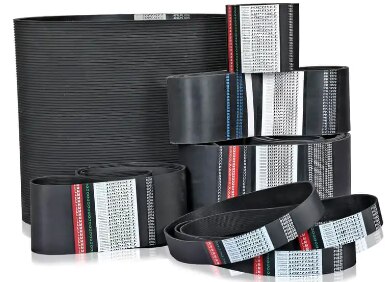 | Poly Belts Poly v-belt allows drive design to meet requirements of power grip and space. View product → |
Frequently asked questions
What is a poly V belt?
A poly V belt is a continuous belt with multiple longitudinal V-shaped ribs that run in matching pulley grooves to transmit power through friction.
When does a poly V belt drive fit better than other belt types?
It fits compact, serpentine drives that need several pulley contacts, flexible routing, and efficient power transmission from one belt.
When is a poly V belt the wrong drive choice?
Choose another drive when the system needs exact synchronous timing, positive tooth engagement, or resistance to unusually severe shock and contamination.
What determines poly V belt service life?
Correct pulley geometry, belt tension, shaft alignment, clean installation, and avoiding forced belt fitting determine service life.
How should you compare poly V belt suppliers?
Compare profile and rib-count accuracy, length tolerances, material construction, traceability, technical support, and the supplier's ability to match the belt to your drive.