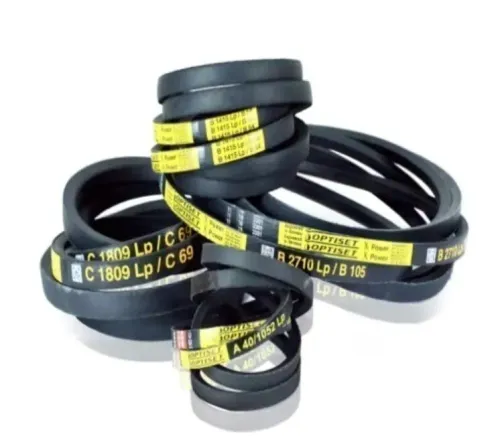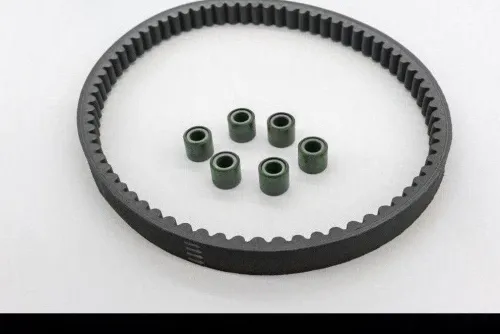
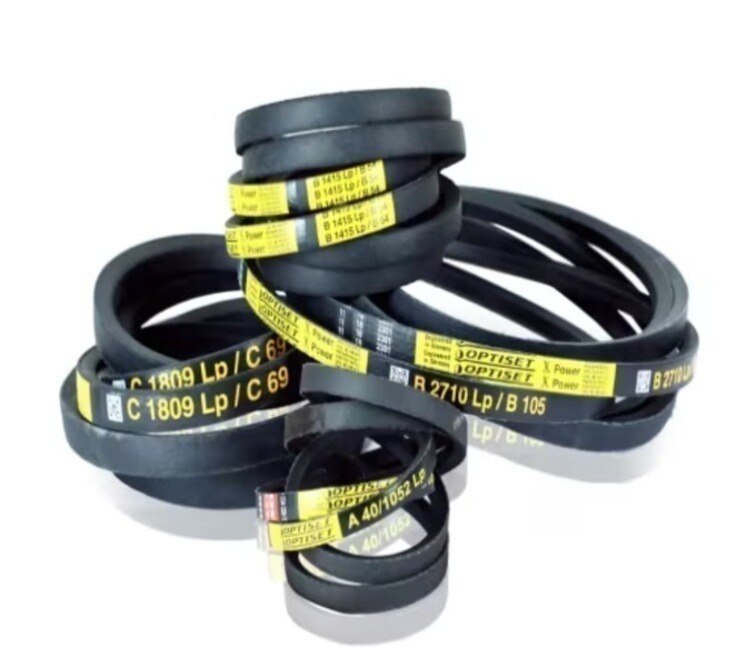
A cogged V-belt is not a toothed timing belt and is not automatically interchangeable with a true flat belt or an existing wrapped V-belt. You will be able to identify the drive type, check pulley compatibility, calculate the required belt specification, account for Mumbai’s operating conditions, and prepare a quotation request that avoids a costly mismatch.
Key takeaways
- Confirm the pulley groove profile before replacing any flat or V-belt.
- Measure belt section, pitch length, pulley diameters and centre distance.
- Choose oil-resistant construction when moisture, dust or lubricant contamination is present.
- Send belt markings, drive dimensions, load details and photos with your quotation request.
Is the existing drive compatible with a cogged V-belt?
A cogged V-belt replaces an existing belt only when the pulley system is designed for the same V-profile.
A true flat belt runs on a flat, usually crowned pulley; a wrapped V-belt has a fabric-covered trapezoidal section; a raw-edge cogged V-belt has notches that reduce bending resistance; a poly-V belt uses multiple longitudinal ribs; and a toothed timing belt engages teeth for positive synchronization.
Cogged V-belts transmit torque by friction in matched V-grooves. Their cogs are not teeth, so they do not engage a toothed pulley or eliminate slip like a timing belt.
This is why cogged belts flat belt for drive conditions in mumbai must not be treated as a drop-in replacement: flat belt drive conditions and V-belt groove conditions are different systems.
Inspect the pulley before measuring belt width:
1. Identify a crowned or flat-belt-specific pulley, V-grooves, or synchronous-drive teeth. A large flat pulley, backside idler, long centre distance, or special tracking arrangement requires machine-maker approval and pulley redesign.
2. Confirm groove profile and angle, belt top width, pitch length, outside length, centre distance, shaft parallelism, shaft alignment, pulley diameters, wrap angle, and available adjustment.
3. Stop the substitution if the pulley cannot be changed to the matched V-groove. Width alone cannot establish compatibility; an incorrect groove seats poorly, slips, overheats, and damages the belt.
How do you select and measure the correct cogged belt?
A correct cogged belt selection starts with design power, not motor nameplate power. Record transmitted power, driver rpm, driven rpm, speed ratio, operating hours, duty cycle, start-up frequency, starting load, shock load, and driven-machine type.
1. Apply the manufacturer’s service factor for those conditions to obtain design power. A compressor starting under load needs a different factor from a lightly loaded fan.
2. Use the exact belt profile, small-sheave pitch diameter, belt speed, and manufacturer’s power-rating table. A/13, B/17, C/22 and metric profiles with similar top widths are not interchangeable; the groove angle and depth must match. Keep the published minimum pitch diameter even with cogged construction, or cogs can crack and cords fatigue.
3. If the marking is unreadable, photograph the belt and measure top width, thickness, cog spacing, and cross-section. Measure effective or pitch length using the maker’s specified method, not by assuming outside length.
4. Record pulley groove count, groove width, groove angle, groove depth, pitch diameter, face width, and shaft centre distance. Check shaft alignment and available adjustment travel before ordering.
5. For multiple-belt drives, specify a matched set. Do not combine old and new belts, even when their markings appear identical.
This cogged belt selection process prevents a visually similar belt from changing the speed ratio, seating incorrectly, or carrying unequal load. If the belt and pulley dimensions disagree, replace or redesign the pulley system rather than forcing the belt into service.
Which belt construction suits Mumbai’s heat, moisture and contamination?
Raw-edge cogged belts improve bending flexibility and reduce bending stress on a permitted small sheave, but they still grip by friction in matched V-grooves. They do not fix an undersized pulley, overloaded drive, incompatible groove or misaligned shaft.
| Option | Flexibility, grip and behaviour | Heat, noise, cost and maintenance |
|---|---|---|
| Raw-edge cogged V-belt | Highest V-belt flexibility; strong groove grip; slip occurs when wet or under-tensioned | Lower bending heat; moderate noise and vibration; moderate cost; inspect cogs and flanks |
| Wrapped V-belt | Less flexible; stable friction grip in clean grooves | More bending heat; quiet, economical and easy to replace; routine tension checks |
| Classical V-belt | Robust grip but larger bending resistance than cogged types | Moderate heat, noise and vibration; lowest cost; widely maintained |
| Narrow or wedge belt | High power per width; requires exact narrow-groove geometry | Efficient with low slip; moderate heat and cost; pulley compatibility is critical |
| Poly-V belt | Very flexible and compact; many ribs share load | Low vibration and noise; sensitive to rib wear, contamination and pulley damage; moderate cost |
| Genuine flat belt | Needs flat or crowned pulley and tracking arrangement; not a V-groove substitute | Low frictional heat when aligned; can slip, track or flutter; system redesign and higher maintenance |
For cogged belts in Mumbai, monsoon water or condensation reduces friction; humidity, mud and salt air corrode sheaves, while dust abrades rubber. Oil, diesel, solvent vapour, ozone, steam and generator or boiler heat attack different compounds, so obtain the maker’s temperature and chemical limits—never assume a standard belt is oil-proof.
Provide ventilation, splash-excluding guards with drainage, and inspect after wet shutdowns.
In combustible dust or hazardous areas, request electrical-conductivity compliance for the exact belt and installation, with ISO 1813 evidence. Choose another construction for severe chemical exposure, excessive shock loading, a flat-belt pulley, or a timing drive requiring positive tooth engagement.
How should you inspect, install and maintain the belt?
Inspect the belt before installation and at every planned shutdown. Glazing or polished flanks indicate slip and heat; cracks at the cogs indicate bending fatigue, excessive heat or an undersized sheave. Missing cogs indicate impact or severe fatigue, while fraying points to misalignment or pulley damage.
- Isolate and lock out the machine. Release belt tension before removing the old belt.
- Inspect pulley grooves for wear, burrs, contamination and incorrect geometry; check bearings for looseness or roughness.
- Align the shafts and pulleys. Place the belt into the grooves without levering it over a pulley, which can damage the cogs.
- Set tension with the belt maker’s force-deflection or frequency method. Under-tension causes slip, glazing and heat; over-tension increases shaft and bearing loads and can shorten bearing life.
- Run the drive under observation. Check tracking, noise, vibration, temperature and whether re-tensioning is needed after the initial run.
- Record oil swelling as chemical attack, abnormal black dust as flank wear or slip, and uneven flank wear as incorrect groove geometry or alignment. Correct the cause before fitting another belt.
Store spare belts cool, dry and shaded, away from sunlight, ozone-producing equipment, oil, solvents and moisture. Do not fold them, compress them for long periods, hang them on narrow hooks or force tight bends. Plan shutdown inspections after wet or dusty operation, and keep spare belts available when contamination could stop the drive.
What should you send a Mumbai supplier before requesting a quotation?
Send a complete drive record, not just a request for “cogged belts in Mumbai.” This prevents a visually similar belt with the wrong groove, cord, or pitch length from being quoted.
1. Record the belt marking, profile, construction, effective or pitch length, outside length if known, top width, thickness, number of belts or ribs, and required quantity.
Add the machine type, motor power, driver and driven rpm, speed ratio, centre distance, both pulley diameters, groove count and condition, duty cycle, start-up and shock load, ambient temperature, oil or chemical exposure, outdoor or monsoon exposure, and any conductive or high-temperature requirement.
2. Attach photographs of the belt marking, cross-section, pulley face, grooves, shaft arrangement, and available adjustment range. Ask for the manufacturer’s data sheet, belt section drawing, dimensions, material or cord construction, power-rating table, minimum sheave diameter, temperature and chemical limits, storage guidance, and test or compliance evidence such as ISO 1813 where required.
3. Require the quotation to state its assumptions and identify total cost beyond the belt: pulley replacement, alignment, tension checks, shutdown time, imported-brand lead time, matched-set availability, local stock, and spare-inventory needs.
Jigna Sales Corporation can use these details to determine whether the requested industrial cogged belts fit the existing drive or require a pulley and design change.
Related product
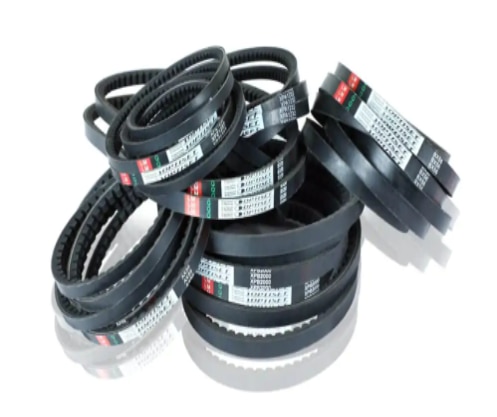 | Cogged Belt Cogged belts are suitable for all industrial applications, particularly where small or sub-minimal sheave diameters are required. View product → |
Frequently asked questions
Can a cogged V-belt replace a belt on a flat-belt drive?
Only when the drive uses grooved pulleys matching the cogged belt’s section and profile. A true flat-belt pulley does not guide or retain a cogged V-belt correctly; converting the drive requires compatible grooved pulleys, alignment and tension checks.
How do you select and measure the correct cogged belt?
Record the belt’s section marking, pitch length, top width, thickness, number of ribs or teeth where applicable, pulley diameters and centre distance. Use the manufacturer’s measurement method because outside, inside and pitch lengths are different dimensions.
Which cogged belt construction suits Mumbai’s heat, moisture and contamination?
Match the cover, rubber compound and reinforcement to the exposure. Use oil-resistant construction near lubricants, a suitable temperature rating near heat sources, and sealed storage and guarding where humidity, water spray or abrasive dust are present.
How should you inspect, install and maintain a cogged belt?
Inspect for cracks, glazing, frayed cords, tooth or rib damage, oil swelling and abnormal wear. Install with the manufacturer’s tension method, align the pulleys, never pry the belt onto the pulley, and recheck tension after the initial running period.
What should you send a Mumbai supplier before requesting a quotation?
Send the belt marking or clear photographs, section and length measurements, pulley sizes, centre distance, speed, power, operating hours, temperature, contamination, quantity and delivery location. Include the machine model and the reason for replacement.