Choosing a belt for automated equipment requires more than matching width and material: you must account for friction, tracking, load, speed, environment and the accuracy of the machine sequence. By the end, you will know where a flat belt drive fits, when a polyurethane timing belt is the safer choice, and what measurements and acceptance checks to give a supplier.
Key takeaways
- Use flat belts for smooth continuous motion without exact shaft phasing.
- Choose a polyurethane timing belt when indexed movement requires positive tooth engagement.
- Record belt width, length, pulley diameters, groove details and shaft spacing.
- Check tension after installation and account for Mumbai heat, humidity and dust.
How a flat belt drive transfers power through automated machinery
A flat belt drive suits automated machinery that needs continuous, smooth motion rather than exact shaft phasing. A belt runs over a driver pulley, transfers torque through friction, and turns a driven pulley on another shaft; an idler or tensioner maintains contact and tension.
Pulley wrap angle, surface condition, alignment and tension determine how much power reaches the driven shaft. The phrase flat belt for drive automated machinery in mumbai describes this practical choice for conveyor sections, packaging equipment, sorting lines, textile machinery, printing equipment and machine-tool auxiliaries.
| Drive type | Movement and behaviour | Best fit |
|---|---|---|
| Flat belt | Smooth continuous conveying or tangential motion; permits slip | Product transfer, spindles and broad contact surfaces |
| V-belt | Higher grip and torque in compact drives; less suited to precise positioning | Fans, pumps and auxiliary shafts |
| Timing belt | Toothed positive engagement; preserves phase and registration | Indexing, synchronized feeders and servo-linked axes |
| Roller chain | High torque and load capacity; noisier and needs lubrication | Heavy conveyors and slow drives |
| Gears | Exact ratio and high torque; needs precise alignment and lubrication | Compact, rigid transmissions |
Do not use a friction belt where stopping must place a product at an exact register. A flat belt can slip during acceleration or peak load; choose a polyurethane timing belt for that sequence. Test any replacement at operating speed, load, acceleration, stopping and washdown, then inspect tracking, seam passage, heat, slip and edge damage.
Guard pulley nip points and rotating shafts.
Where flat belts fit—and where positive timing matters more
Continuous conveying, product transfer, spindle drive and tangential transmission suit a flat belt drive because friction provides smooth motion across a broad contact surface. Use it on conveyor sections, packaging and sorting lines, textile machinery, printing equipment and machine-tool auxiliaries. Do not use it where shaft phase, cut position or product registration must remain exact.
| Option | Slip and synchronization | Strengths | Main limitation |
|---|---|---|---|
| Flat belt | Permits slip; no positive timing | Quiet, clean, high-speed operation and broad contact | Sensitive to pulley parallelism, runout and alignment; limited torque control |
| V-belt | Permits slip; no indexing | Good grip, compact drives and higher torque than a flat belt | More heat, noise and bending loss; poorer high-speed efficiency |
| Timing belt | Teeth prevent slip and preserve phase | Exact indexing, registration and repeatable acceleration | Needs matching pulleys, correct tension and accurate alignment |
| Roller chain | Positive engagement; little slip | High torque and durable load transmission | Noisier, requires lubrication and exposes the line to dirt |
| Gear drive | Positive engagement; exact ratio | Highest positional accuracy and compact high-torque transmission | Costly, rigid, noisy if worn and intolerant of centre-distance errors |
Choose a polyurethane timing belt when an automated sequence stops, cuts, fills or places at a defined position. A flat belt can drift under starting torque, peak load or moisture, so a successful unloaded trial proves little. Specify the actual industrial belts by belt type, not merely “industrial belt.”
Flat belt or polyurethane timing belt for indexed movement
Choose a toothed polyurethane timing belt when a servo-driven sequence must place each part at the same pitch, stop at a defined position, or maintain shaft phase. A friction flat belt permits slip: tension, pulley wrap, surface contamination and alignment changes can shift registration.
Use it for continuous conveying or transfer where small positional drift is acceptable.
| Option | Registration behaviour | Best fit |
|---|---|---|
| Friction flat belt | Slip is possible; torque depends on friction | Continuous conveying, broad product contact, non-indexed transfer |
| Polyurethane timing belt | Teeth engage pulley grooves and preserve phase | Indexing, cut-to-length feeding, pick-and-place positioning |
| Polyurethane Teflon belt | Low-stick surface can reduce drive traction | Release-focused conveying, not automatic high-grip power transmission |
Do not specify “industrial belts” alone. Record belt width, thickness, tensile rating, minimum pulley diameter, operating speed, allowable temperature, chemical exposure, joint type and required coefficient of friction. Select a high-grip drive surface for a flat belt; a PTFE-faced belt can slide on the drive pulley even when its polyurethane body is strong.
If registration is critical, choose the timing belt after checking tooth pitch, pulley tooth count and the system’s permissible positional error.
Measurements and pulley details to record before ordering
Measure the installed flat belt drive before choosing a replacement. Record each pulley’s outside diameter, face width, shaft diameter, shaft-to-shaft centre distance, rotation direction, and the belt’s running path. Photograph the arrangement, including idlers, tensioners, guides and the splice or endless joint.
- Isolate the machine and remove the belt without stretching it. Lay it flat and measure its neutral-line length, width and thickness; record whether the stated length was measured on the inside, centre line or outside.
- Measure the pulley diameters at the belt contact surface, not across a flange. If the original belt is unavailable, calculate the open-belt length from centre distance and pulley pitch diameters, then allow for the machine’s available take-up travel.
- Record the usable pulley face width, crown height or profile, surface finish, runout, and any grooves. Note oil, dust, rust, scoring, glazing, sharp edges and worn crowns; these defects cause slip or edge wandering.
- Check that shafts are parallel, pulleys are coplanar, and the belt has adequate wrap on the driver. Record the tensioner position and the required belt tension if specified by the machine builder.
Do not replace a flat belt with pu cord because both contain polyurethane. PU cord needs its own diameter, hardness, welded joint, pretension and grooved-pulley dimensions.
Installation, tension checks and Mumbai operating conditions
Install with the shafts parallel, pulley faces in the same plane, and the belt centred on the driver and driven pulleys. A skewed pulley makes the belt walk, while a damaged or contaminated pulley surface causes slip.
- Lock out the machine, clean the pulley surfaces, and inspect flanges, bearings, fasteners, splice, and frame for corrosion or damage.
- Fit the belt without levering it over a pulley; forcing it can damage the splice or reinforcement.
- Set the manufacturer’s specified tension using a tension gauge or stated span-deflection method. Do not cure slip by excessive tension, which raises bearing loads.
- Jog the drive, then run it unloaded at low speed. Check tracking, edge flutter, noise, heat, and slip before increasing speed and load; recheck tension after the initial running period.
For Mumbai humidity, monsoon washdown, coastal air, oil mist, or dust, verify compatibility for the belt, splice or fasteners, pulley coating, bearings, and frame. Oil reduces friction; abrasive dust wears the belt and pulley. Use only the belt maker’s approved cleaning method, not an arbitrary solvent.
Specify industrial belts by material, width, thickness, tensile rating, minimum pulley diameter, speed, temperature, joint type, and friction requirement. A pu cord is not a direct substitute for a flat belt. Confirm the same details for an imported replacement.
How to write a usable flat-belt specification for procurement
A belt labelled only “industrial belts” is not a procurement specification. Ask the supplier for a written proposal that identifies the belt’s construction and confirms it suits the actual drive.
1. State the application as “flat belt for drive automated machinery in Mumbai,” then provide belt width, thickness, length-measurement method, tensile rating, operating speed, transmitted power or starting torque, minimum pulley diameter, pulley material, and required coefficient of friction.
2. Describe the environment: operating temperature, humidity, washdown chemicals, oil mist, dust, and product-contact requirements. If you need a polyurethane teflon belt, write polyurethane with PTFE coating, PTFE surface thickness, temperature range, and FDA or food-contact status where applicable. PTFE lowers friction and improves release; it can also reduce traction on a drive pulley.
3. Specify the joint: endless, welded, finger-spliced, or mechanically fastened. Request the joint’s allowable speed, thickness variation, and seam-passage limits.
4. Require drawings or data confirming pulley parallelism, runout, tracking direction, and minimum wrap. A supplier should flag misalignment instead of prescribing belt dressing.
5. Agree on acceptance testing before purchase: actual speed, load, acceleration, stopping, and washdown. Record slip, tracking, edge damage, seam passage, temperature rise, and pulley alignment.
Jigna Sales Corporation can help compare a friction flat belt with a synchronous alternative when the line’s phase accuracy makes slip unacceptable.
Related product
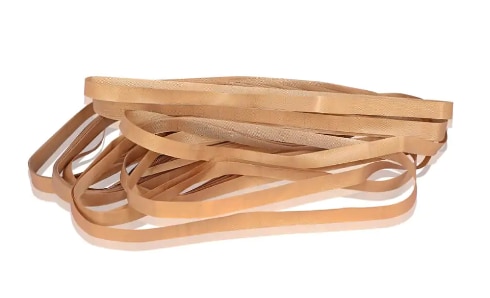 | Polyurethane Teflon Belt PU cord /Teflon belt has High Modulus Polyurethane compound which resists ozone and weather condition, having strength of smooth drives with high... View product → |
Frequently asked questions
How does a flat belt drive transfer power through automated machinery?
A driver pulley transfers torque to a flat belt through friction. The belt turns the driven pulley, while an idler or tensioner maintains contact and tension.
When should you choose a flat belt instead of a timing belt?
Choose a flat belt for smooth continuous motion. Choose a positive timing belt when the machine requires exact shaft phasing or indexed movement.
What measurements should you record before ordering a flat belt?
Record belt width, belt length, pulley diameters, pulley face width, shaft spacing, pulley alignment, belt thickness and the tensioning arrangement.
What should you check when installing a flat belt in Mumbai conditions?
Align the pulleys, set the specified tension, inspect tracking and recheck tension after initial running. Account for heat, humidity, dust and oil exposure.
How do you write a usable flat-belt procurement specification?
State the belt material, width, thickness, length, joint or endless construction, pulley dimensions, operating speed, transmitted power, temperature, contamination and delivery requirements.