A marking such as 5M, 7M, or 11M does not by itself tell you whether you are buying a five-metre belt, a synchronous-belt pitch, or a conventional V-belt. You will be able to identify the correct belt reference, calculate the required length, test whether your machine can accept a longer option, and prepare a quotation request that different suppliers can compare.
Key takeaways
- Confirm the belt profile before comparing length.
- Calculate replacement length from pulley diameters and centre distance.
- Do not substitute 3M-JB, 5M-JB, 7M-JB, or 11M-JB belts.
- Send pulley sizes, centre distance, markings, and photos to suppliers.
What “standard” and 5M, 7M, or 11M actually mean
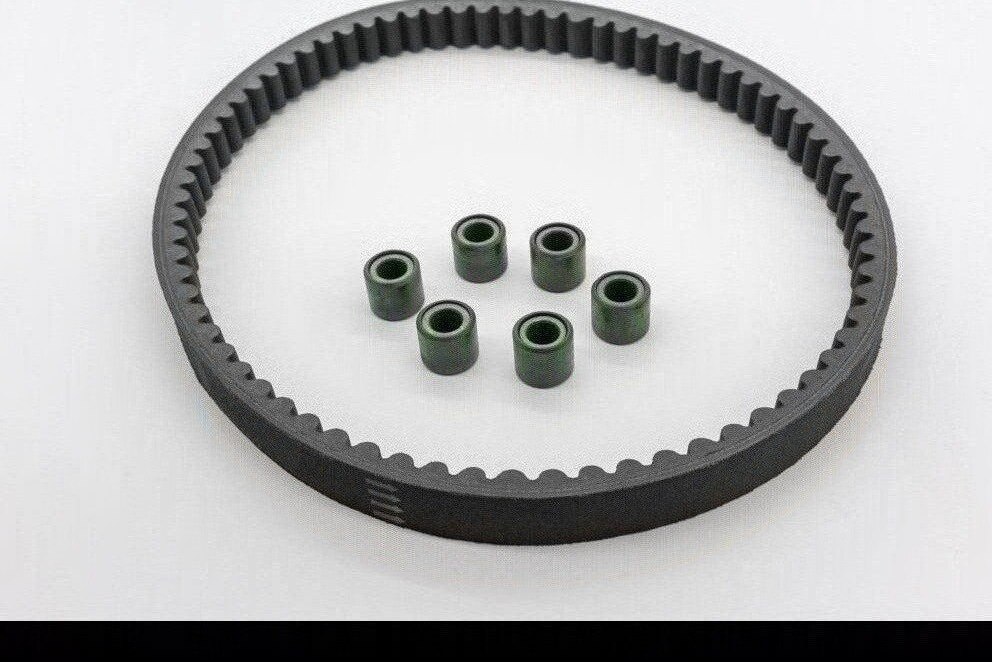
“Standard” describes a belt’s recognised section or profile, not necessarily its length. Conventional V-belts use designations such as Z, A, B, C, D, SPZ, SPA, SPB, and SPC. A 5M marking commonly identifies a synchronous toothed belt with a 5 mm tooth pitch, not a V-belt cross-section or a five-metre length.
A V-belt wedges into a sheave groove and transmits power through friction. A synchronous belt engages matching pulley teeth, so pitch and tooth geometry control engagement rather than wedging friction. The terms are not interchangeable.
- Ask for the belt type: friction-drive V-belt or synchronous toothed belt.
- Confirm the section or tooth profile, belt width, construction, and tooth count where applicable.
- Treat 7M belts and 11M belts as unverified designations. They might describe a proprietary profile, a model number, an approximate length in metres, or a transcription error; do not assume they are standard timing pitches.
- Require the length-reference method. Nominal length, pitch or datum length, inside length, and outside length are different measurements, especially across V-belt profiles.
- Reject a quotation that says only “5M belts,” “7M belts,” or “11M belts.” It must state the actual profile, dimensions, construction, length, and measurement convention.
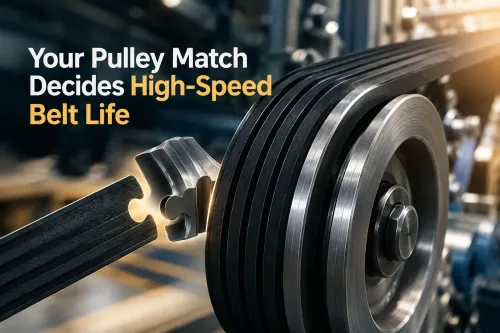
Before comparing v belt suppliers, match the belt to the pulley or sheave. A correct-looking length with the wrong groove section or tooth profile can run loose, bottom out, ride high, slip, or wear rapidly.
How to identify the replacement from the machine and calculate its length
Select the replacement from the machine when the old belt or documentation cannot be trusted. A complete inspection prevents a correct-looking length from hiding the wrong section, tooth profile, or pulley geometry.
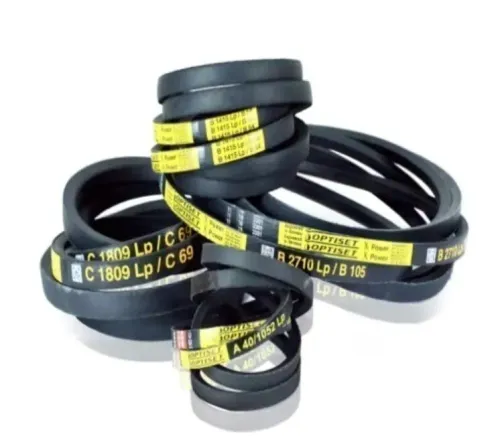
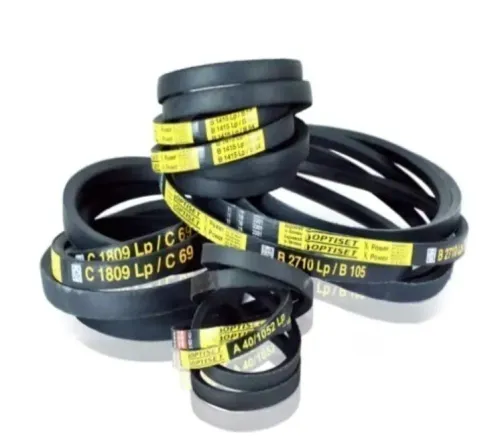
- Photograph every marking on the belt, including faded characters and manufacturer codes.
- Identify the belt section or tooth profile, such as A, SPA, or a synchronous tooth form.
- Measure the existing belt with a flexible tape or belt-measuring tool; do not estimate from its appearance.
- Record the large and small pulley diameters, shaft-centre distance, and pulley groove or tooth geometry.
- Find the manufacturer’s belt-length designation and state whether it refers to inside, outside, datum, or pitch length.
- Check whether the pulley has V-grooves for wedging friction or teeth for positive engagement.
For an open two-pulley drive, calculate length with pitch or datum diameters and centre distance: L = 2C + π(D + d)/2 + (D − d)²/(4C). D is the large-pulley reference diameter, d the small-pulley reference diameter, and C the shaft-centre distance.
Use the same reference diameter named in the belt specification, not an arbitrary outside measurement.
If you only know inside or outside length, ask v belt suppliers for the manufacturer’s correction or conversion data; the offset differs by V-belt profile. Never force a belt over a pulley to measure or install it.
That can damage tensile cords, while v belt suppliers need the correct adjustment method and length reference to quote an interchangeable belt.
Why 3M-JB, 5M-JB, 7M-JB, and 11M-JB are not interchangeable
The number in 3M-JB, 5M-JB, 7M-JB, or 11M-JB does not prove belt length, pitch, or section. Check the manufacturer’s drawing for pitch, tooth or rib geometry, belt width, construction, and the compatible pulley or sheave before ordering.
| Designation | What must be verified | Matching drive |
|---|---|---|
| 3M-JB | Pitch, tooth form, width, construction | Toothed pulley with the same profile |
| 5M-JB | 5 mm pitch only if the drawing confirms it; verify width and tooth form | Synchronous pulley with matching teeth |
| 7M-JB | Confirm whether it is a proprietary profile, model code, or length reference | Pulley specified by the manufacturer |
| 11M-JB | Confirm the same details; do not assume an 11 mm timing pitch | Compatible toothed pulley or sheave |
In a synchronous belt, pitch is the tooth-to-tooth spacing, and tooth count determines pitch length. A conventional v belt works differently: top width, thickness, flank angle, and groove dimensions create wedging contact. A 5M timing profile cannot replace an A- or SPA-section V-belt because both appear in one machine quotation.
For a toothed belt, match pulley tooth form, pitch, width, and alignment. For a V-belt, match groove angle, groove depth, and section. If “5m belts,” “7m belts,” or “11m belts” means approximate length in metres, the supplier must state actual length and measurement convention.
A transposed model number can produce an incompatible sheave, even when the printed length looks correct.
What a longer belt changes in the drive—and whether the machine can accept it
A longer belt is not a simple replacement: with pulley diameters unchanged, it increases centre distance or requires the motor to move, an idler to be added, or a jackshaft installed. The longer span increases vibration and whip, lowers practical maximum speed, and demands more installation clearance.
Pulley speed stays unchanged, but shaft and bearing loads rise if tension is excessive. Check motor-slide range, minimum and maximum centre distance, guard clearance, tensioner travel, small-sheave wrap, and whether you can install the V-belt without levering it over a pulley. Levering can damage tensile cords.
Specify installation tension and recheck it after a short running-in period. Too much tension overloads bearings; too little causes slip, glazing, heat, and rapid wear.
| Option | Main trade-off | Check before choosing |
|---|---|---|
| Single long V-belt | Simple, but more span vibration and lower available power | Speed, wrap, tension, clearance |
| Banded or matched set | Better stability and power sharing, with more stiffness and cost | Matching tolerance and pulley width |
| Idler or jackshaft | Restores adjustment or routing, but adds maintenance and bearings | Alignment, contamination, guarding |
| Synchronous belt | No slip and positive tooth engagement, but teeth can shear or ratchet and contamination matters | Matching tooth profile, pulley, tension |
5M belts, 7M belts, and 11M belts may need a different solution than a long V-belt. Multiple-belt drives require matched-length belts within the specified matching tolerance.
What to send V belt suppliers before ordering a longer option
Send each v belt suppliers a complete machine specification, not just “5M,” “7M,” or “11M.” Without the length convention and drive data, quotations are not comparable and a longer belt can be incompatible despite a similar nominal length.
- State belt type, profile or tooth designation, applicable standard, nominal length, datum or pitch-length reference, inside or outside length if known, width, construction, and number of belts.
- Record pulley diameters, groove or tooth data, centre distance, and available adjustment travel.
- Add speed, transmitted power, start-stop frequency, shock load, ambient temperature, and contamination.
Request a manufacturer drawing, pulley compatibility confirmation, tension target, matched-set tolerance, and installation instructions. Jigna Sales Corporation can help a Mumbai or Maharashtra buyer compare rubber, polyurethane, timing, and longer power-transmission options, but the machine data determine interchangeability.
| Request type | Required match | Main failure if mismatched |
|---|---|---|
| Conventional V-belt | Section, groove angle and depth, datum or effective length, width | Slip, heat, poor seating, or bearing overload |
| Synchronous belt | Pitch, tooth profile, width, tooth count, pitch length, and pulley tooth form | Tooth jump, rapid wear, or no engagement |
RFQ example: Conventional V-belt: “Supply two SPB belts, datum length _, for pulleys _ mm and _ mm, centre distance _ mm.” Synchronous belt: “Supply one _M belt, _ mm wide, ___ teeth, for matching toothed pulleys.” Flag any mismatch; do not substitute by nominal length.
Frequently asked questions
What do standard, 5M, 7M, and 11M mean on belts?
Standard usually identifies a recognised V-belt section such as Z, A, B, C, SPZ, SPA, SPB, or SPC. Markings such as 5M, 7M, and 11M commonly identify synchronous belts by tooth pitch, not V-belt length.
How do I identify the correct replacement V-belt?
Record the existing belt’s complete marking, measure its top width and thickness, identify the pulley grooves, and measure pulley diameters and shaft centre distance. Use these dimensions to verify the belt section and length.
Can I replace a 3M-JB belt with a 5M-JB, 7M-JB, or 11M-JB belt?
No. These synchronous belt designations use different tooth pitches and dimensions, so they require matching pulleys. They are not interchangeable.
What changes when I install a longer belt?
A longer belt increases the required centre distance or leaves less adjustment for tensioning. Check the machine’s slide rails, take-up travel, pulley alignment, guard clearance, speed ratio, and tension range before ordering.
What information should I send V belt suppliers before ordering a longer belt?
Send the belt marking, profile, measured length, pulley tooth count or diameter, shaft centre distance, pulley widths, available adjustment travel, machine model, operating speed, load, and clear photos of the belt and pulleys.