
At high rotational speed, a Poly V belt drive is limited by more than nominal horsepower: centrifugal tension, rib bending, pulley geometry, heat, and alignment all affect whether the belt survives. By the end, you will be able to check the drive calculation, choose a compatible section and rib count, read belt markings, and specify the installation details that determine service life.
Key takeaways
- Calculate belt speed before approving a high-speed drive.
- Match belt section, rib count, and pulley grooves.
- Control heat, alignment, and tracking to limit fatigue.
- Specify the complete drive when requesting industrial belts.
How Multiple Ribs Transmit Power at High Speed
A Poly V belt transfers power by friction between its longitudinal ribs and matching pulley grooves. The pulley’s rotating grooves pull the ribbed belt surface, creating a tight-side tension T1 and slack-side tension T2; usable power is P = (T1 − T2)v, where v is belt speed.
More ribs spread the load across the pulley width, helping a poly v belt drive transmit power smoothly at high speed and fit smaller pulley diameters.
That advantage has limits. Centrifugal tension, repeated bending, slip, pulley runout, heat, and unequal rib loading can reduce allowable power before the theoretical benefit of higher belt speed appears. Rib count is not a substitute for a power calculation.
| Drive type | Power-transfer principle | Better fit |
|---|---|---|
| Classical V-belt | Wedge friction in one or more deep grooves | Larger pulley diameters, moderate speed, and conventional industrial drives |
| Narrow V-belt | Wedge friction in a narrower, deeper section | Higher power from a compact width than a classical V-belt |
| Poly V belt | Many longitudinal ribs share frictional load across one pulley | High speed, small pulleys, serpentine layouts, and limited radial space |
| Flat belt | Friction across a broad, flat contact surface | Long centres, high efficiency, and drives needing crowned pulleys |
| Timing belt | Tooth engagement with matching pulley teeth | Exact synchronization, fixed speed ratio, and zero slip |
Choose a Poly V belt when smooth friction drive, compact pulleys, and flexible routing matter more than positive timing. Choose a timing belt for indexing or synchronization; choose a V-belt when wedge traction and a simpler conventional layout outweigh compactness.
A high-speed design still needs matched grooves, correct tension, balanced pulleys, adequate wrap, and thermal verification.
Check Belt Speed, Centrifugal Tension, and Application Load
A catalogue rpm is not enough: approve a poly v belt drive only after checking belt speed, centrifugal tension, power, geometry, duty, and temperature as one system. Calculate belt speed from the effective pulley diameter and shaft rpm: v = πDn/60.
Centrifugal tension rises with the square of speed, reducing the tension available to transmit torque.
Use the belt manufacturer’s power-rating table for the exact section, length, rib count, pulley diameters, and speed. Do not treat extra ribs as a substitute for calculation; uneven alignment or tension can leave some ribs overloaded. Apply a service factor for start-up torque, frequent cycling, reversing, and shock loads.
- Confirm the small and large effective pulley diameters, shaft rpm, centre distance, and wrap angle. Low wrap on the small pulley reduces contact and increases slip risk.
- Check the manufacturer’s maximum belt speed, centrifugal-tension limit, minimum pulley diameter, and required installation tension for the complete arrangement.
- Include duty cycle, start frequency, driven inertia, and peak—not just rated—power. A motor’s nameplate rating will not reveal a severe acceleration load.
- Check ambient temperature, nearby heat sources, dust, oil, and ventilation. Measure belt temperature after thermal equilibrium; a short no-load run can hide failure.
- Treat every backside idler as a design change: verify its diameter, position, wrap, speed limit, and added bending loss.
These figures belong in the specification sent to manufacturers and suppliers of industrial belts, not in a selection based on nominal horsepower alone.
Choose the Section, Rib Count, and Matching Pulley
Select PJ, PK, PL, or PM from the belt section and pulley data, not from belt width alone. Their rib pitch and groove geometry differ, so a belt that physically fits can ride on the groove sides, bottom out, or lose rib engagement.
| Section | Common rib pitch | Selection check |
|---|---|---|
| PJ | 2.34 mm | Confirm PJ groove profile and its minimum pulley diameter |
| PK | 3.56 mm | Confirm PK groove profile and its minimum pulley diameter |
| PL | 4.70 mm | Confirm PL groove profile and its minimum pulley diameter |
| PM | 9.40 mm | Confirm PM groove profile and its minimum pulley diameter |
Use the belt marking to verify section, rib count, and length. A marking such as PJ 6 900 identifies a PJ belt with six ribs and a nominal 900 mm length, but confirm whether that length is effective, pitch, or datum length under the cited standard.
Do not compare an effective-length belt with a pulley dimension taken at another datum.
- Match the pulley’s groove pitch to the belt section; do not substitute a visually similar pulley.
- Check the pulley’s effective or pitch diameter against the belt data and confirm it is at least the stated minimum diameter.
- Calculate rib count from the required power per rib, then round up to the next available belt and pulley width.
- Verify both pulleys have the same section, pitch, groove angle or profile, and usable rib count.
Ask poly v belt manufacturers and poly v belt suppliers for dimensional drawings, power-per-rib tables, minimum diameters, and the length-measurement standard. A catalogue listing only length and rib count cannot validate a high-speed drive.
Control Heat, Tracking, and Fatigue During Installation
Prevent high-speed failure by setting tension with the belt manufacturer’s method, then checking the complete drive at operating temperature. Excessive tension raises bearing load; insufficient tension causes slip, heat, and rib wear. Centrifugal tension also rises as Tc = m v², so doubling speed creates four times the centrifugal component.
Use this installation checklist:
- Seat every rib fully in its matching groove; a partially raised rib quickly overheats and damages the pulley.
- Align pulley faces and shafts, then rotate the drive by hand to confirm tracking.
- Measure pulley runout and inspect balance, keyway, hub, and machining; eccentricity creates cyclic tension, while imbalance adds vibration and bearing load.
- Remove oil, coolant, dust, and belt dressing. Contamination promotes slip.
- If using a backside idler, verify its diameter, position, wrap angle, surface, and allowable speed. A smooth idler bends the belt in reverse and does not transmit the same capacity as a ribbed pulley.
Check these conditions before release:
| Check | Verify | Failure prevented |
|---|---|---|
| Tension | Manufacturer’s deflection or frequency value | Slip, rib damage, bearing overload |
| Alignment | Shafts parallel and pulley faces in plane | Edge wear and tracking loss |
| Runout | Dial-indicator reading within pulley-maker’s limit | Cyclic vibration and tension |
| Seating | No rib standing above a groove | Local overheating |
Run the poly V belt drive through its real duty cycle, including loaded starts. Measure belt temperature only after thermal equilibrium; a short no-load test can miss heat from slip, bending, or bearing drag. Record temperature, vibration, tracking, and tension for maintenance on industrial belts.
Specify the Complete Drive Before You Buy
Do not compare belts on length, rib count, nominal horsepower, and rpm alone. Give each Poly V belt manufacturers and poly v belt suppliers the complete drive data, then require the calculation basis and operating limits in writing; a catalogue entry that omits centrifugal tension or heat limits cannot validate a high-speed choice.
1. Request the belt section, such as PJ, PK, PL, or PM; belt length; rib count; dimensional standard; pulley groove profile; effective diameters; and minimum permitted pulley diameter.
2. Supply transmitted power, driver and driven shaft rpm, centre distance, wrap angle, duty cycle, start-up torque, shock load, and the rating table used. Ask how allowable power changes with belt speed.
3. Get allowable belt speed, operating temperature range, centrifugal-tension limit, initial tension range, and the exact tensioning method for that span and load. Request a heat check after thermal equilibrium, not only a short no-load run.
4. Declare every idler’s diameter, location, wrap angle, and contact surface. Confirm reverse-bending and speed limits; a smooth backside idler does not provide ribbed-pulley drive capacity.
5. Ask for alignment and runout tolerances, guarding requirements, installation instructions, and replacement-identification details. For industrial belts, retain the manufacturer’s calculation sheet with the purchase record.
Jigna Sales Corporation belongs in that comparison when you need section selection, pulley matching, and replacement identification rather than a quote based on belt length alone.
Related product
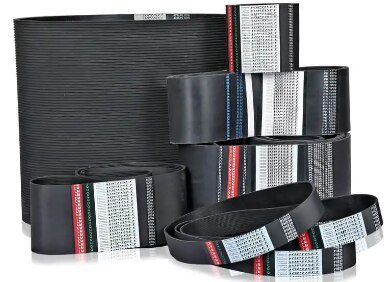 | Poly Belts Poly v-belt allows drive design to meet requirements of power grip and space. View product → |
Frequently asked questions
How do multiple ribs transmit power at high speed?
Longitudinal ribs engage matching pulley grooves through friction. The drive transmits usable power from the difference between tight-side and slack-side tension multiplied by belt speed.
What must you check before using a poly V belt at high speed?
Check belt speed, centrifugal tension, and the application load before selecting the drive.
How do you choose the correct poly V belt and pulley?
Choose the belt section, rib count, and matching pulley groove profile as one compatible set.
How can you reduce heat, tracking problems, and fatigue?
Install the belt with correct alignment and tension, then control heat and tracking during operation to reduce fatigue.
What information should you give poly V belt manufacturers or suppliers?
Specify the complete drive, including belt section, rib count, pulley details, operating speed, load, and installation requirements.