A notched V-belt is not automatically a high-speed belt: the correct choice depends on its profile, sheave geometry, linear speed, tension, and operating environment. By the end, you will be able to identify the existing drive, calculate belt speed, compare raw-edge and wrapped constructions, specify the right replacement, and inspect it before failure.
Key takeaways
- Confirm belt profile, length, speed rating and sheave dimensions before ordering.
- Choose a cogged V-belt for compact, high-speed bends—not toothed engagement.
- Align sheaves and set tension with the belt maker’s measurement method.
- Inspect guards, fasteners, vibration, temperature and belt tracking before restart.
How a cogged V-belt differs from smooth and synchronous belts
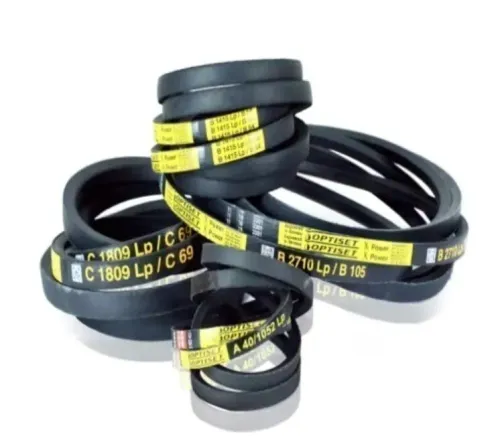
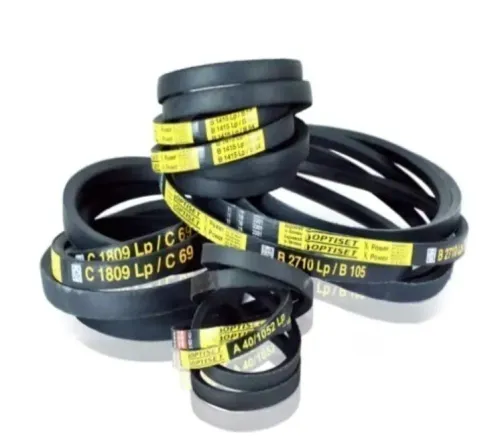
A cogged V-belt is a friction-drive belt with molded notches across its inner surface. The notches run around the belt and let it bend longitudinally around a sheave; they do not engage pulley teeth.
Compared with a smooth classical V-belt, this construction flexes more readily and can reduce bending stress on a small sheave, but the manufacturer’s published minimum sheave diameter still controls selection.
| Construction | What changes | Choose it when |
|---|---|---|
| Raw edge cogged belt | Exposed, precision-formed sidewalls contact the sheave grooves directly, improving flexibility and heat dissipation | The specified flexibility and speed rating are required |
| Wrapped cogged belt | A fabric cover protects the belt and changes friction and contamination behaviour | Handling damage or contamination protection matters |
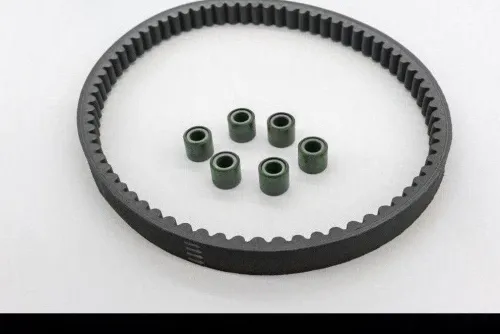
“Cogged belt” and “toothed V belt” are common trade terms for this friction-drive construction. Do not confuse either term with a synchronous timing belt: its transverse teeth mesh with matching pulley grooves to maintain positive synchronization. A cogged V-belt has no such positive engagement and can slip when tension, wrap angle, or load is incorrect.
Select the profile, compound, reinforcement, sheave diameter, and rated speed from the manufacturer’s data; “high speed” alone proves nothing. Raw edge construction is not automatically the faster choice.
Which high-speed applications and drive factors determine suitability
Suitability depends on the complete drive geometry, not the label “high speed.” A cogged V belt can serve a fan, blower, pump, compressor, machine-tool spindle, or other friction drive only after checking power, speed, sheave dimensions, and loading.
Record these drive factors before selecting a belt:
- Belt section, transmitted power, service factor, shaft speed in rpm, centre distance, smaller and larger sheave diameters, wrap angle, and number of belts.
- Manufacturer’s rated power at the actual rpm and sheave diameters, minimum sheave diameter, maximum linear speed, temperature range, tension-setting method, belt-length tolerance, and electrical-conductivity status where static discharge matters.
| Belt family | Common sections | Selection warning |
|---|---|---|
| Classical V belt | A, B, C, D | Cogged and smooth versions do not share identical ratings |
| Narrow V belt | SPZ, SPA, SPB, SPC | Dimensions and ratings differ from classical sections |
| Cogged designation | X prefix in some systems | Confirm the manufacturer’s section dimensions and rating |
Calculate belt speed from pitch diameter: v = πdn/60, where v is metres per second, d is pitch diameter in metres, and n is rpm. Do not substitute outside diameter. Centrifugal force rises approximately with the square of belt speed, increasing tension, vibration, and bearing load after a modest rpm increase.
Respect the published minimum sheave diameter; an undersized pulley accelerates notch cracking, cord fatigue, heat, and bending. Confirm adequate wrap on the smaller sheave. Low wrap can require revised centre distance or a speed-rated slack-side idler. A toothed V belt is still a friction belt, not a synchronous timing belt.
How to identify the replacement belt and compare supplier quotations
Start with the installed belt, not the generic phrase “cogged belt.” Photograph every marking: section designation, manufacturer code, length code, production identification, and matched-set identification. Verify inside length, top length, and pitch length separately; substituting one for another can produce the wrong fit.
- Record top width, thickness, notch profile, and the number of ribs or belts.
- Measure sheave-groove width, depth, included angle, pitch diameter, and centre distance; inspect whether the groove matches the belt section.
- Ask cogged belt manufacturers for a drawing or datasheet confirming these dimensions.
| Quotation item | What to request | Why it matters |
|---|---|---|
| Rated performance | Power at actual rpm and pulley diameters; minimum sheave diameter; maximum linear speed | A generic high-speed claim does not establish suitability |
| Operating limits | Temperature range; belt-length tolerance; tension-setting method | These determine fit, heat performance, and commissioning |
| Material properties | Oil resistance, heat resistance, antistatic status, and conductivity-test documentation | These are separate properties, not consequences of being cogged |
For a multi-belt drive, specify a matched set or an approved banded belt. Mixing manufacturers, production lots, or visibly different wear states can leave one belt slipping while the others carry excess load. Jigna Sales Corporation can compare options when you provide drive data, not only the old belt name.
Related product
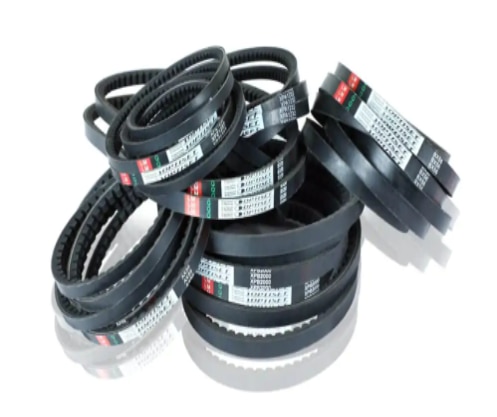 | Cogged Belt Cogged belts are suitable for all industrial applications, particularly where small or sub-minimal sheave diameters are required. View product → |
How to install and tension a cogged belt without damaging the drive
1. Lock out the motor, isolate electrical and mechanical stored energy, and wait until the sheaves stop completely. Loosen the motor base or adjustment mechanism, move the sheaves close enough to place the cogged V belt over them, and never lever it onto a pulley with a screwdriver or pry bar.
2. Align the sheave faces and shafts with a straightedge or laser. Correct angular and parallel misalignment before applying tension; otherwise the belt can track against one flange, overheat, and wear its sidewalls. Check wrap on the smaller sheave, especially at high speed.
3. Measure the centre distance, then use the belt manufacturer’s table for the specified span length, force, deflection, or frequency method. Do not use thumb pressure or visual tightness. The value depends on belt section, transmitted power, rpm, sheave diameter, span, service factor, and number of belts.
Insufficient tension causes slip, glazing, heat, and unstable speed; excessive tension raises shaft and bearing loads and can damage cords.
4. Rotate the drive by hand to seat the belt, recheck alignment, and confirm that belts in a matched set share the load. If an idler is required, verify its speed rating and place it on the slack side unless the design specifies otherwise.
Run the drive under observation, then recheck tension after the supplier’s stated run-in period. In a poorly ventilated Mumbai enclosure, select the raw edge cogged belt compound and cover for heat, humidity, oil mist, dust, and water spray.
What to inspect before a high-speed drive returns to service
Before restart, inspect each sheave for polished or worn grooves, burrs, corrosion, contamination, and excessive radial runout. Confirm that high-speed sheaves are concentric and dynamically balanced where required, especially on fans, spindles, and compressor drives. Check the guard for belt contact and confirm ventilation prevents heat accumulation.
- Examine the cogged belt for glazing, sidewall wear, cracked notch roots, missing cogs, frayed edges, exposed reinforcement, oil swelling, and unusual rubber dust. Oil or coolant on sheaves promotes slip; water splash can do the same. Trapped dust and coastal salt accelerate sheave corrosion and wear.
- Replace the belt when damage reaches the reinforcement. Replace it also when repeated retensioning, temperature rise, vibration, or measurable slip indicates misalignment, undersized sheaves, inadequate wrap, overload, contamination, or an incorrect belt rating.
- Do not treat quiet running or greater flexibility as proof of suitability. Cogged belt manufacturers rate each construction for specific speed, profile, compound, reinforcement, and sheave diameter.
| Finding | Required check | Consequence or action |
|---|---|---|
| Solvent, combustible-dust, or hazardous-area service | Request documentation for the applicable conductivity test | Visual inspection cannot prove antistatic compliance; “oil resistant,” “heat resistant,” and “antistatic” are separate properties |
| After commissioning | Compare vibration, speed stability, and operating temperature with the machine baseline | A recurring deviation identifies a drive problem, not merely a belt needing replacement |
| High humidity, spray, or contamination | Clean and dry sheaves, then inspect again | Contamination can cause slip even when the belt appears intact |
Frequently asked questions
How does a cogged V-belt differ from a smooth V-belt and a synchronous belt?
A cogged V-belt uses molded notches to bend around smaller sheaves while transmitting power through friction. A smooth V-belt has a continuous inner surface, while a synchronous belt uses teeth that engage matching pulley grooves and does not rely on friction for synchronization.
Which factors determine whether a cogged V-belt suits a high-speed drive?
Check the belt profile, transmitted power, rotational speed, sheave diameter, center distance, wrap angle, operating temperature, alignment and available space. Confirm the selected belt’s speed and power ratings against the drive conditions.
How do you identify the correct replacement cogged V-belt?
Record the belt profile, outside or effective length marked on the belt, number of ribs when applicable, sheave dimensions and drive arrangement. Compare these details with the supplier quotation rather than matching length alone.
How should you install and tension a cogged V-belt?
Switch off and isolate the machine, inspect the sheaves, fit the belt without prying it over the flange, align the sheaves, and apply the manufacturer’s specified tension. Recheck tension after a short run and never use excessive force to stretch the belt.
What should you inspect before returning a high-speed drive to service?
Verify guard clearance, sheave alignment, belt tracking, tension, fasteners, abnormal vibration, noise, belt temperature and signs of oil, cracking, fraying or glazing before releasing the drive.