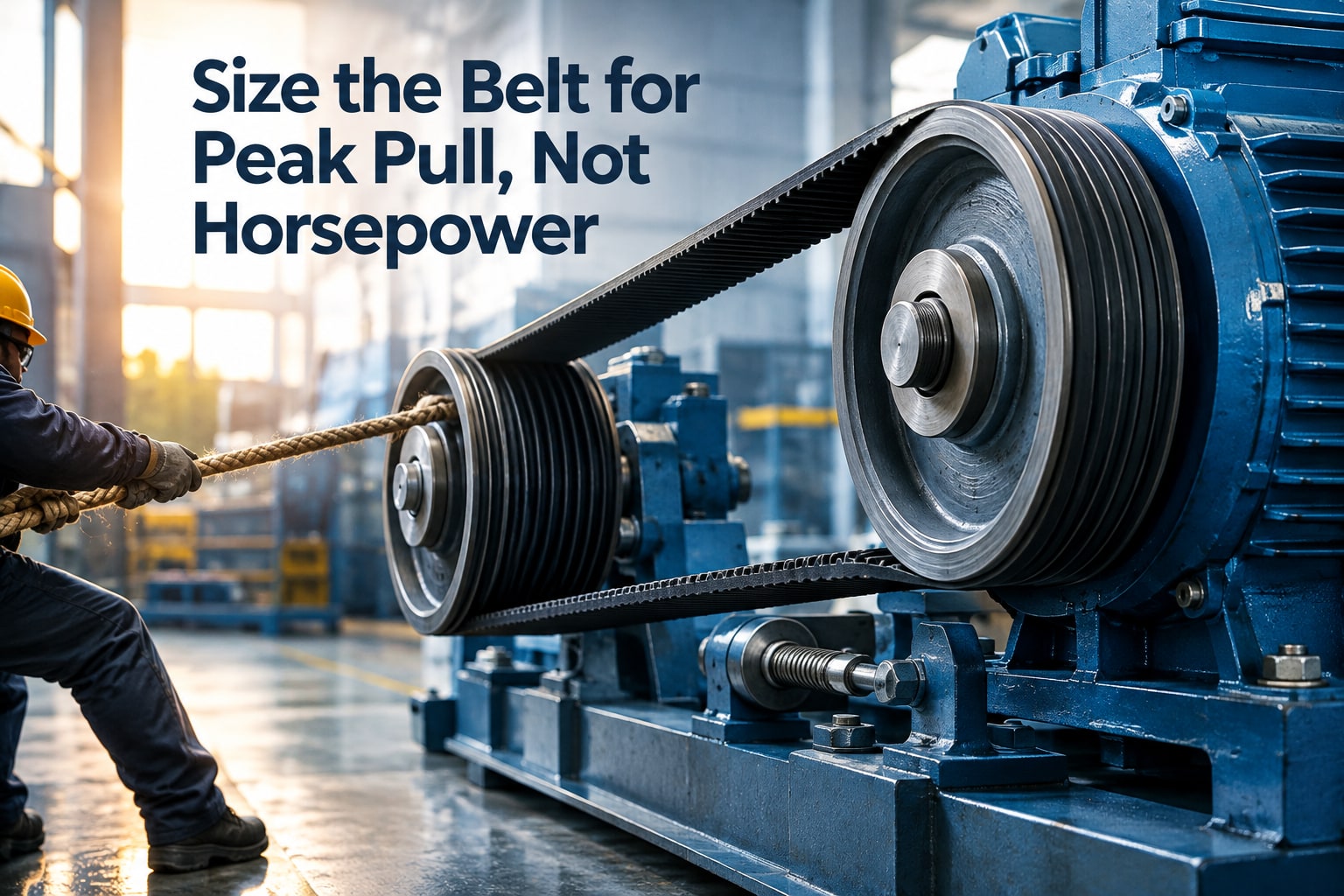
A high motor rating does not by itself identify the right cogged belt: load shocks, shaft speed, pulley geometry, belt construction, and the number of belts all affect capacity. By checking design power, dimensions, sheave condition, markings, and duty cycle in sequence, you can specify a belt that fits the drive and survives its actual load.
Key takeaways
- Confirm whether you need a friction belt or a synchronous toothed belt.
- Use service factors to convert motor power into the drive’s design load.
- Match belt section, sheave diameter, belt count, and tension as one system.
- Record belt markings, dimensions, and operating conditions before requesting replacements.
Identify the belt construction before comparing capacity
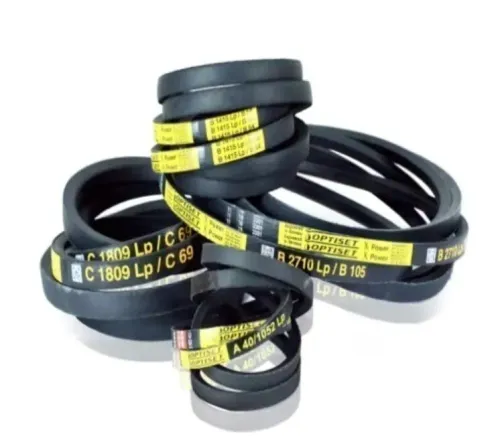
A cogged V belt is still a friction belt. Its longitudinal notches flex around the sheave and reduce bending stiffness, but they do not engage pulley teeth or provide positive synchronization.
| Construction or drive | How to identify it | When it applies |
|---|---|---|
| Wrapped cogged V belt | Fabric covers the rubber sidewalls and cogs | General V-belt service where abrasion protection and forgiving sheave contact matter |
| Raw edge cogged V belt | Precision-ground rubber sidewalls and exposed longitudinal cogs | Compact drives, smaller sheaves, and close groove conformity when pulleys are in good condition |
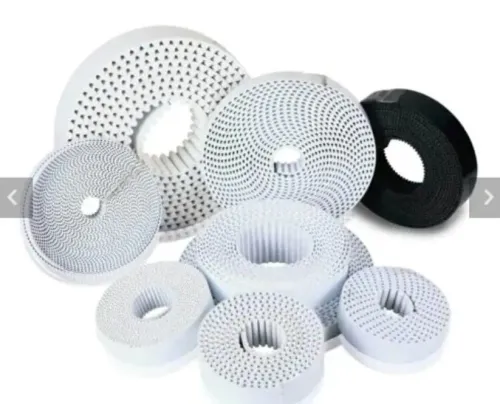
| Synchronous timing belt | Teeth engage matching pulley grooves | Timing, indexing, and no-slip synchronization |
| Chain | Metal links engage sprocket teeth | Positive engagement where lubrication, noise, and impact loads are acceptable |
A raw edge cogged belt can conform closely to the groove, but that advantage makes defects costly. Check sheave wear, alignment, groove angle, and profile matching before choosing it; polished or damaged grooves can cause slip, edge wear, and rapid failure.
Do not substitute profiles by appearance. SPZ, SPA, SPB, and SPC narrow or wedge belts require their matching groove geometry and are not interchangeable with A, B, C, or D sections. A Poly V-belt uses multiple ribs and a different pulley.
Specify “raw edge cogged V belt,” “wrapped cogged V belt,” or “synchronous timing belt.” “Cogged belt” alone leaves the construction and pulley type ambiguous.
Convert motor power into the drive’s real design load
A drive is genuinely high torque when its required belt pull, especially at low shaft speed, exceeds what motor horsepower alone suggests. Start with motor power and rpm: P = Tω, so torque T = P/ω. As speed falls, the same torque demands greater belt pull at the pulley even when transmitted power is modest.
Check the driven load before choosing industrial belts:
| Load | What to check | High-torque warning |
|---|---|---|
| Conveyor | Starting load, incline, loaded restart, belt acceleration | A full-load restart can exceed running demand |
| Crusher | Jam, stall, trapped material, shock reversal | Design for shock and the chosen overload-release strategy |
| Compressor | Starting torque, pressure at start, pulsation | Pressure-loaded starts increase peak torque |
| Pump | Fluid inertia, head pressure, frequent starts | A high-inertia impeller can dominate acceleration |
| Cyclic machinery | Starts per hour, braking, reversing, dwell time | Repeated torque reversals fatigue cords and shafts |
Build design power from nameplate horsepower or kilowatts using the belt manufacturer’s service factors for driven machine, prime mover, daily hours, starts per hour, acceleration, braking, reversing, and shock. Include torsional vibration, variable-speed operation, and low-temperature starts; cold rubber and lubricant increase starting resistance.
A cogged V belt can slip during a jam, limiting shock transferred to a gearbox, but slip creates heat and speed loss. A synchronous belt prevents normal slip yet transfers a jam directly into shafts and pulleys. Give the supplier the complete duty cycle, not merely motor rating and nominal rpm.
Size the belt, sheaves, and belt count as one system
A drive transmits design power only when the belt, sheaves, length, wrap, and belt count are rated together; a wide belt alone proves nothing.
1. Calculate design power from motor horsepower or kilowatts, applying the manufacturer’s service factors for driven load, hours, starts, acceleration, braking, reversing, and shock.
2. Select the belt section from the manufacturer’s rating table. Use the exact raw edge cogged belt or wrapped profile, not a generic industrial belts label.
3. Check the small-sheave diameter against that section and operating speed. Cogging does not remove the minimum diameter: an undersized pulley causes notch cracking, cord fatigue, heat, and short life.
4. Calculate pitch length using pitch diameters and centre distance: Lp = 2C + 1.57(D + d) + (D − d)²/(4C). Confirm whether the catalogue uses pitch or datum length; do not substitute outside length.
5. Verify the speed ratio, belt speed, and arc of contact on the small sheave. Rating changes with pitch length, wrap, small-pulley diameter, and belt speed, so use every correction factor in the table.
6. Divide design power by corrected power per belt, then round up to the required belt count. Specify a matched set; never add one new belt to worn belts or assume extra grooves cure poor tension or alignment.
Record top width, belt height, groove angle, groove count, and centre distance. A proposed drive fails the check if any dimension, rating, or minimum-diameter limit is unknown.
Inspect the pulley and set tension for peak belt pull
An otherwise correctly sized belt can fail because the sheave is wrong. A raw edge cogged belt exposes precision-ground rubber sidewalls, so worn grooves can cut, polish, or unload those sidewalls faster than a wrapped belt.
| Fault | What it does | Result |
|---|---|---|
| Worn or incorrect groove | Changes contact and concentrates load | Slip, heat, and rapid sidewall wear |
| Parallel or angular misalignment | Loads one edge and reduces effective belt count | Edge failure and unequal belt loading |
| Excessive runout | Varies tension once per revolution | Vibration, noise, and cyclic overload |
Use this physical inspection checklist before fitting the belt:
- Compare groove angle and spacing with the cogged V belt profile; do not assume a similar-looking section fits.
- Inspect both groove sidewalls for polishing, steps, flaking, or wear lips.
- Remove burrs and corrosion, then clean residue from the grooves.
- Check flanges for bending, cracks, looseness, or contact marks.
- Measure radial and axial sheave runout with a dial indicator.
- Verify that each sheave diameter meets the belt maker’s minimum for that section and operating speed.
- Check parallel and angular alignment with a straightedge or laser tool.
Set pretension with the exact belt maker’s force-deflection method, frequency method, or tension tool. Never copy a value from another section or belt length: too little tension causes slip and heat, while too much increases shaft and bearing loads.
Confirm compatibility with oil, solvents, abrasive dust, ozone, humidity, temperature, and low-temperature starts; these conditions can attack rubber, cord, or adhesion.
Read the old belt and write a specification suppliers can match
Record the complete belt marking, physical dimensions, pulley geometry, and operating duty before ordering; “industrial belt” or “high torque” is not a specification.
| Marking field | What to record |
|---|---|
| Section code | A, B, C, D, SPZ, SPA, SPB, SPC, or the exact profile shown |
| Length designation | Outside, inside, pitch, or datum length; record the printed unit |
| Cog profile | Notched form and any stated tooth, pitch, or profile code; a cogged V belt is not a timing belt |
| Construction | Raw edge or wrapped |
| Manufacturer code | Brand, factory code, batch code, and every legible suffix |
A photograph or partial marking cannot prove interchangeability. Measure the old belt and sheaves, especially after edge wear or repeated breakage; do not rely on an old invoice. Confirm the section, pitch or datum-length system, top width, height, groove angle, groove spacing, pulley diameter, and belt count by physical measurement.
Write the purchase specification with the required length tolerance, cord and rubber material when critical, operating speed, minimum sheave diameter, temperature, oil or chemical exposure, starts per hour, reversing or shock duty, and applicable dimensional standard, such as ISO 4184 where it applies. State the complete duty cycle.
Jigna Sales Corporation can compare a requested profile with a suitable replacement when you provide these measurements and duty details, rather than asking suppliers to guess from “high torque.”
Related product
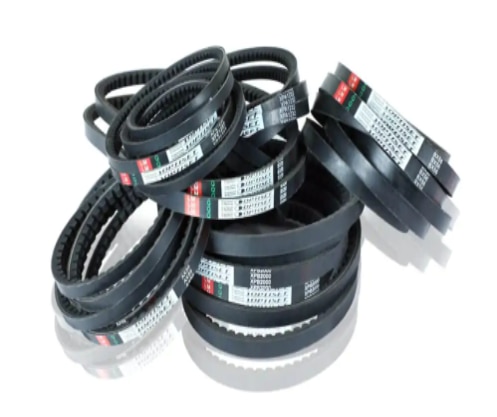 | Cogged Belt Cogged belts are suitable for all industrial applications, particularly where small or sub-minimal sheave diameters are required. View product → |
Frequently asked questions
Is a cogged V belt a synchronous belt?
No. A cogged V belt remains a friction belt; its longitudinal notches help it flex around the sheave but do not engage pulley teeth.
How do you calculate the real design load for a cogged belt drive?
Start with motor power, then account for operating hours, start-up torque, shock loads, speed, driven equipment, and the applicable service factor.
What must be matched when sizing a cogged belt drive?
Match the belt section, effective length, sheave diameters and grooves, speed ratio, centre distance, and the number of belts as one system.
How should you specify a replacement cogged belt?
Record the belt’s printed markings, section, length, construction, number of ribs or belts, sheave details, motor power, speeds, and operating conditions.