A robot axis can lose repeatability even when its belt appears intact: the wrong tooth profile, undersized pulley, poor pretension, or unverified tensile rating can cause tooth jumping and position error. By the end, you will know how to specify the belt and pulley, check the drive geometry, size the transmission for servo loads, and compare Indian suppliers on evidence rather than sales claims.
Key takeaways
- Match belt pitch and profile to the pulley teeth.
- Choose rubber for quieter, compact motion with moderate shock damping.
- Calculate acceleration loads, tooth engagement, and required service life.
- Ask manufacturers for material, cord, tolerance, and test documentation.
Where rubber timing belts fit in robotic motion systems
Rubber timing belts transfer motion through positive tooth engagement, giving a repeatable speed ratio without normal slip under correct tension. Their compact layout, low lubrication needs, low noise, and moderate shock damping suit industrial timing belts used where chains would add bulk, noise, or contamination.
They also contribute relatively low backlash and can synchronize multiple axes from one drive.
| Mechanism | How the belt helps | Why synchronous engagement fits |
|---|---|---|
| Robot-axis drives | Transfers motor motion to a joint or actuator | Maintains a repeatable ratio in a compact package |
| Pick-and-place systems | Moves grippers rapidly between stations | Supports fast reversals without normal friction slip |
| Conveyors | Synchronizes product travel with robot timing | Keeps belt speed tied to pulley rotation |
| Gantry systems | Drives X, Y, or Z carriages | Coordinates long travel and multiple axes |
| Indexing tables | Advances stations by fixed increments | Repeats angular positions through tooth count |
| SCARA mechanisms | Couples motors to horizontal arms | Fits compact arm layouts and coordinated movement |
| Cartesian systems | Drives linear axes through pulleys and belts | Provides synchronized travel along separate rails |
The belt is not a rigid positioning element. Belt elasticity, tooth clearance, pulley runout, pretension variation, and joint compliance affect servo tuning and positioning accuracy; stretch, vibration, thermal growth, tooth wear, and aging can increase error. Excessive load or poor tension can cause tooth jumping.
For searches involving rubber timing belt manufacturers in India industrial robotics, specify the actual axis duty rather than asking for a generic belt. A rubber timing belt suits moderate loads and clean, quiet motion, but a suspended vertical axis still needs a brake or redundant load support.
Black contamination, extreme temperature, severe shock, or demanding repeatability can justify a geared reducer, ballscrew, or chain.
Choose rubber or polyurethane by the robot’s operating conditions
Rubber timing belts suit robotic axes with moderate loads, frequent starts, limited lubrication, and a need for quiet motion with some shock damping. Choose polyurethane when oil, coolant, abrasion, contamination, higher tensile stiffness, or cleaner operation dominates the decision.
| Criterion | Rubber | Polyurethane |
|---|---|---|
| Tensile stiffness and flexibility | More compliant and flexible; damping reduces noise and shock | Stiffer, with lower stretch and stronger load transmission |
| Chemicals, oil, and heat | Neoprene handles general service; HNBR suits higher heat or oil exposure | Strong resistance to oil, chemicals, and tooth wear; confirm the rated temperature |
| Cleanliness and noise | Quiet and lubrication-free, but rubber dust can matter | Clean-running and quiet; better for controlled environments |
| Joining and load capacity | Molded endless construction gives reliable high-load service | Endless, welded, open-ended, or joined construction; joining can limit load |
| Contamination | Sensitive to abrasive grit and incompatible fluids | Better against many contaminants, but verify compound compatibility |
Use rubber for a flexible, quieter drive where positional demands tolerate belt compliance. Use polyurethane for higher stiffness and repeatability, or when oil and contamination accelerate rubber degradation; industrial timing belts still need profile-specific data, not a material label alone.
Both materials have torsional compliance, belt stretch, thermal growth, vibration, tooth-jump risk, and backlash from incorrect tension. Accuracy declines as the belt ages. A vertical axis needs a brake and redundant load support, never belt tension alone. Extreme shock, temperature, contamination, or repeatability requirements justify a geared reducer, ballscrew, or chain.
For timing belts India procurement, compare the actual construction and ratings.
Specify the profile, pitch, pulley, and pitch length before ordering
Provide the supplier with the complete existing-drive specification, not only a belt width or outside length. A belt marked T10 is not interchangeable with AT10, and neither matches HTD 10M; tooth geometry and pitch must match the pulley.
1. State the belt profile and pitch: T5, T10, AT5, AT10, HTD 3M, HTD 5M, HTD 8M, or HTD 14M. Add belt tooth count, pitch length, width, and tensile-member construction, such as fiberglass, aramid, or steel. Pitch length is measured along the pitch line, not around the belt’s outside circumference.
2. Specify the pulley completely: matching profile and pitch, tooth count, face width, bore, keyway or clamp arrangement, flange arrangement, material, and runout limit. Also provide the installed centre distance and drive speed. Include the motor and driven pulley tooth counts, because these determine the speed ratio and tooth engagement.
3. Verify the replacement against the drive geometry before ordering. Calculate each pitch circumference as tooth count multiplied by pitch, check the actual centre distance, and confirm that the proposed pitch length falls within the supplier’s tolerance. Inspect pulley teeth for burrs, wear, eccentricity, and correct axial retention.
A rubber timing belt with the same nominal outside length can still be wrong if its pitch line differs. For timing belts India procurement, give rubber timing belt manufacturers in India the profile, pitch, pulley data, and measured geometry; do not order rubber timing belts by width alone.
Size the belt for acceleration, tooth engagement, and service life
A servo belt must survive peak acceleration and deceleration torque, not just continuous motor torque. Calculate torque from motor output, reflected load inertia, speed, start-stop frequency, and shock load; then check belt width against allowable tensile load and tooth-shear capacity. Steady running can look safe while acceleration causes ratcheting or tooth shear.
Check the geometry before approving the drive. For pulley tooth counts N1 and N2 and pitch p, calculate pitch circumference as Np and pitch diameter as Np/π.
Use the belt pitch length L in L = 2C + π(D1 + D2)/2 + (D2 − D1)²/(4C) to solve centre distance C. The smallest pulley governs tooth bending and tensile-member flexing; its diameter, wrap angle, and engaged-tooth count must meet the supplier’s limits.
Approximate engaged teeth as the small-pulley tooth count multiplied by wrap angle divided by 360.
Use this checklist for rubber timing belts on industrial robotics:
- Request peak torque, speed, acceleration, deceleration, shock factor, cycle frequency, and required rated life.
- Confirm belt width, allowable tensile load, allowable tooth-shear load, minimum pulley diameter, and rated-life basis.
- Verify operating temperature and chemical compatibility with oil, coolant, cleaning agents, and dust.
- Set pretension using the supplier’s frequency, elongation, or force-deflection method; do not maximize it.
- Reject a selection based only on maximum tensile strength; excess pretension overloads bearings, while too little causes tooth jumping and positional error.
For rubber timing belt manufacturers in India serving industrial robotics, compare documented ratings for the actual drive. Industrial timing belts and rubber timing belts need evidence, not visual tightness.
Compare rubber timing belt manufacturers in India on engineering evidence
Choose on verifiable engineering data, not the lowest quotation. A company calling itself one of the rubber timing belt manufacturers in India may be a manufacturer, stockist, authorised distributor, importer, or belt fabricator. Request its manufacturing location, belt compound, tensile member—fiberglass, aramid, or steel—batch identification, dimensional tolerances, test data, warranty terms, and matching pulley availability.
Ask each timing belts India supplier for the same evidence:
- Profile and pitch: T5, T10, AT5, AT10, HTD 3M, 5M, 8M, or 14M
- Width, pitch length, tooth count, and pitch-length tolerance
- Minimum pulley diameter, temperature range, and chemical compatibility
- Allowable tensile and tooth-shear loads, rated-life basis, and test method
- Recommended pretension procedure, lead time, replacement availability, and documents supplied with each batch
| Evidence | Manufacturer | Stockist, importer, or fabricator |
|---|---|---|
| Origin | Named production site and process | External source or undisclosed site |
| Traceability | Batch record and test report | Seller invoice or relabelling |
| Engineering support | Construction and pulley compatibility | Catalogue matching only |
Compare quotes only after matching profile, width, pulley tooth count, centre distance, and pitch-line length; outside circumference is not pitch length. A cheaper nonstandard belt can create incorrect tension or a costly production stoppage.
Jigna Sales Corporation is worth considering for rubber timing belt manufacturers in India industrial robotics procurement when it supplies the robot’s required construction, matching pulleys, and verification documents—not merely because it has an Indian sales address.
Related product
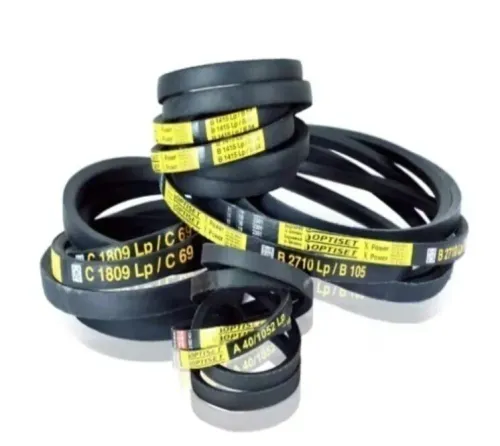
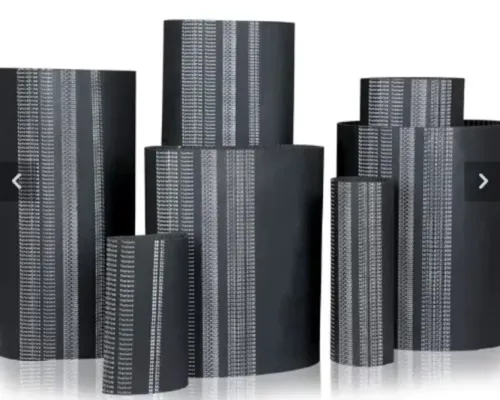
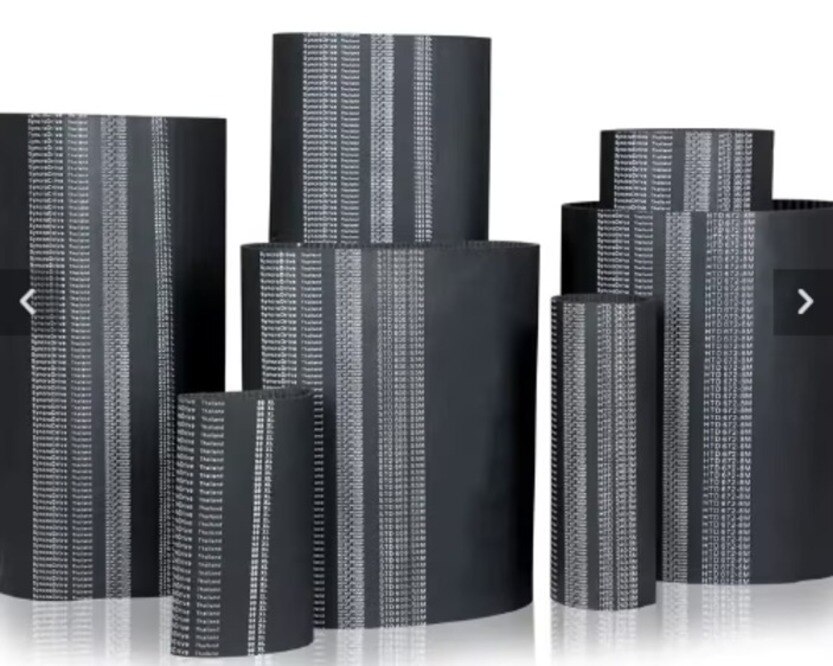
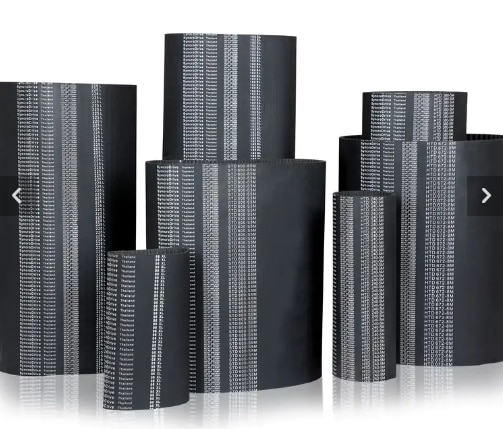 | Rubber Timing Belts Timing belts make less noise compare to chain belts and gear belts and has high transmission capacity and efficiency. View product → |
Frequently asked questions
Where do rubber timing belts fit in robotic motion systems?
They synchronise shafts and transfer motion without normal slip when correctly tensioned, making them useful for compact robotic axes and mechanisms.
How do you choose rubber or polyurethane timing belts?
Choose based on operating temperature, chemical exposure, noise, shock, flexibility, load, and the required resistance to wear and elongation.
What must you specify before ordering an industrial timing belt?
Specify the tooth profile, pitch, pulley tooth count, belt pitch length, width, material, cord construction, and operating conditions.
How do you size a timing belt for industrial robotics?
Check transmitted torque, acceleration load, tooth engagement, allowable belt tension, pulley diameter, belt width, and target service life.
How should you compare rubber timing belt manufacturers in India?
Compare their dimensional tolerances, material and cord details, technical drawings, test reports, traceability, replacement support, and application guidance.