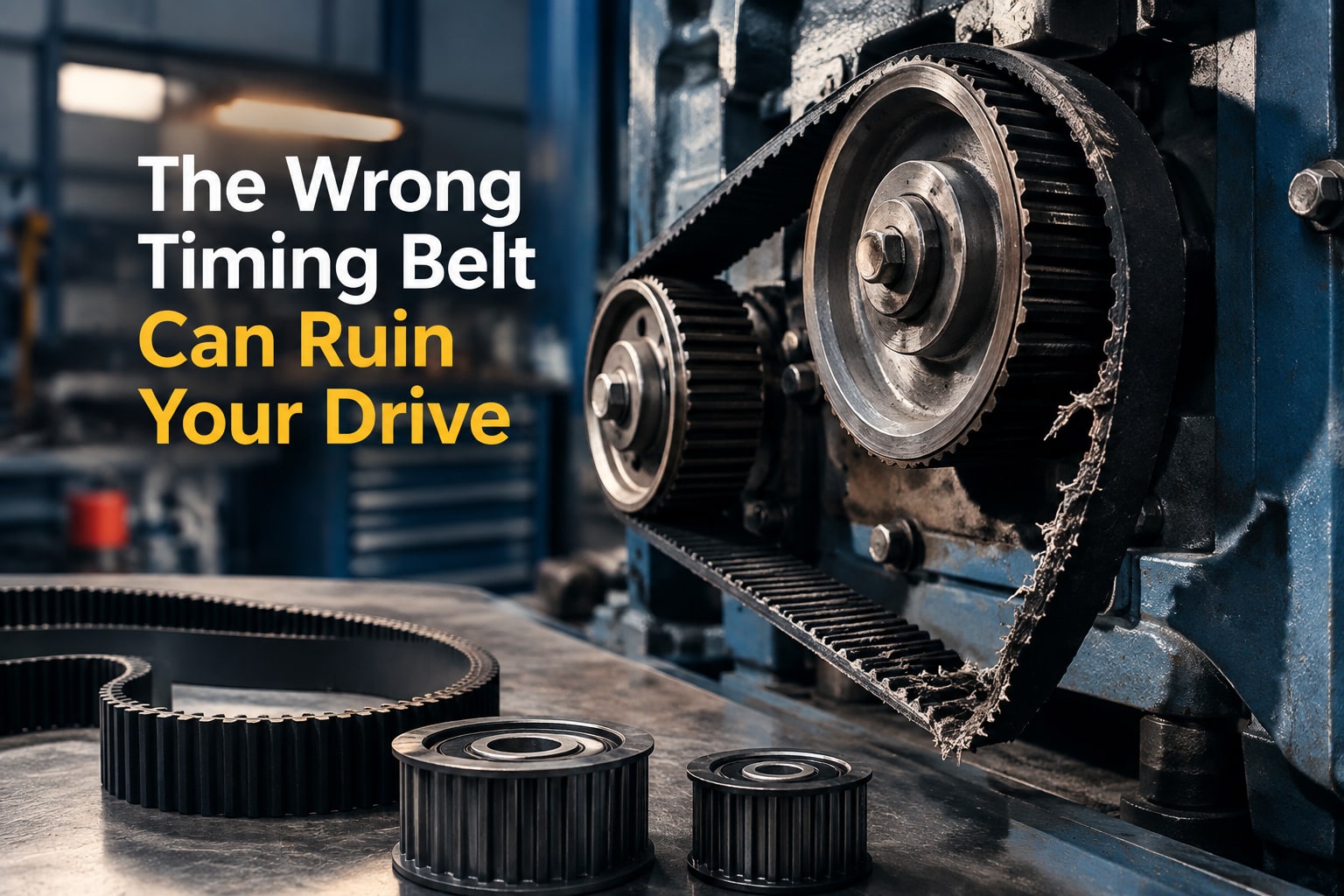
Ordering a replacement by belt length and width alone can produce the wrong tooth geometry, pulley engagement or tension rating. By the end, you will know what to measure, how to inspect the drive, which belt construction fits the duty and what to require from timing belt dealers in Mumbai before installation.
Key takeaways
- Record belt marking, tooth profile, pitch, width and drive speed before requesting quotes.
- Match the belt construction to load, temperature, chemicals and pulley diameter.
- Replace worn or damaged pulleys before installing the new timing belt.
- Compare dealers on technical verification, traceability, stock and replacement support.
Collect the Belt and Drive Data Before Requesting a Quote
Give timing belt dealers in Mumbai a complete drive record, not only the old belt’s length and width. Different tooth geometries can jump, wear rapidly or fail under load even when the dimensions appear close.
1. Copy every belt marking: profile and pitch, such as T, AT, HTD, STD, XL, L, H, XH or XXH; belt width; tooth count; and pitch length. For an unmarked belt, count the teeth and measure pitch length around the tooth centres, not the outside circumference.
Record each pulley’s tooth count, outside diameter and the shaft centre distance.
2. Identify the belt form and construction. State whether the replacement is an endless moulded rubber belt, endless welded polyurethane belt or open-ended polyurethane belt joined to length. Include tensile-cord type, tooth-facing material, coating, double-sided teeth, oil resistance, high-temperature construction or any other special feature.
3. Describe the duty: continuous running, indexing, servo positioning or high-shock start/stop operation. Add speed, transmitted power, start-up load and the smallest pulley diameter.
4. Report exposure to oil, coolant, dust, outdoor ozone and heat. Ask for the compound’s permissible temperature range and chemical-compatibility data; contamination can shorten the life of industrial timing belts even when the size matches.
Send clear photographs of the marking, belt teeth and pulleys. Request confirmation against the manufacturer’s rating tables, not a visual cross-reference alone. Ask whether the quoted belt is a standard catalogue item or a special construction.
Decode the Marking and Choose the Correct Belt Construction
A replacement works only when its tooth geometry, pitch, construction and application rating agree with the drive. Read the marking for profile and pitch together: T, AT, HTD and STD are metric families; XL, L, H, XH and XXH are inch families.
Matching pitch alone is unsafe because different tooth shapes will not seat correctly in the pulley.
Material determines resistance and load behaviour. Check the tensile-cord type, tooth-facing compound and permissible temperature and chemical range, especially with oil, coolant, dust or outdoor ozone. Ask for the manufacturer’s rating table, minimum pulley diameter and allowable speed; do not rely on a dealer’s visual cross-reference.
A conveyor belt can fail in a servo, indexing or shock-loaded drive despite matching dimensions.
| Belt form | What it means | When it applies |
|---|---|---|
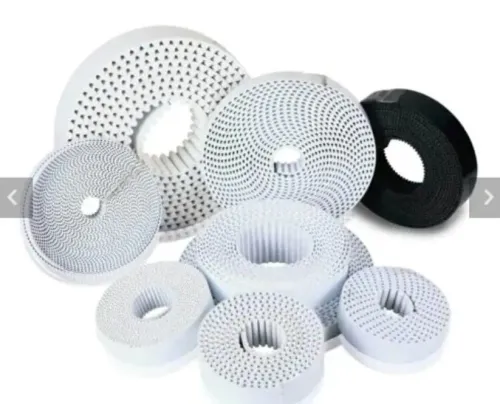
| Endless moulded rubber timing belts | Continuous rubber body with embedded tensile cords | High-load, high-speed or precision drives specified for moulded construction |
| Endless welded polyurethane belts | Polyurethane loop joined by welding | Clean, flexible applications where the manufacturer permits a welded joint |
| Open-ended polyurethane belts | Supplied by length and joined during installation | Linear motion or moderate-duty drives designed for a site-made joint |
Confirm whether the original is oil-resistant, high-temperature, double-sided, coated, joined or custom-length before substituting a standard belt. A search for timing belts india is only a starting point; specify profile, pitch and construction in the RFQ. Never treat generic rubber timing belts as chemically equivalent.
Inspect the Pulleys Before You Approve a Replacement
A new belt that matches the old length and width can fail quickly if it runs on a damaged pulley. Replace the pulley when its tooth form no longer matches the specified profile; dimensions alone do not prove compatibility for industrial timing belts.
1. Lock out the machine, remove the guard and release belt tension before inspection. Never judge pulley wear with the belt still loaded.
2. Clean each pulley and inspect the teeth under good light. Replace a pulley with hooked, polished, chipped, flattened or visibly worn teeth.
3. Check the tooth profile and pitch against the belt marking or manufacturer’s drawing. T, AT, HTD, STD, XL, L, H, XH and XXH profiles are not interchangeable.
4. Count every pulley tooth and compare it with the drive record. Replace a pulley if the tooth count, pitch or face width does not suit the approved belt, even when the old belt’s dimensions appear correct.
5. Check for a crowned or damaged flange, a bent shaft, looseness, corrosion and pulley wobble. Correct the shaft or alignment fault before installing the new belt.
Replace the mating pulley too when both pulleys show wear or the new belt will continue running against a visibly damaged tooth form. A replacement belt on one worn pulley receives uneven tooth loading, jumps teeth and fails prematurely.
Ask the timing belt dealer to confirm the pulley profile and tooth counts, not just belt length and width.
Install, Tension and Test the New Timing Belt Safely
Prevent tooth jumping and bearing overload by installing the belt slack, setting tension to the specified method, and checking alignment before applying power.
1. Stop the machine, isolate every energy source, apply lockout/tagout, and remove the guard. Never release tension on a rotating drive.
2. Loosen the motor or tensioning mechanism and remove the old belt without levering it over pulley teeth. Record the original adjustment only as a reference; generic V-belt deflection rules do not apply to synchronous drives.
3. Inspect both pulleys for hooked, polished, chipped or worn teeth, damaged flanges, debris and shaft misalignment. Replace a pulley when its tooth form no longer matches the belt profile.
4. Fit the specified construction—molded endless, welded endless polyurethane or open-ended joined polyurethane—without twisting the belt. An open-ended joint is not an automatic substitute for an endless belt in a high-load, high-speed or precision-indexing drive.
5. Seat every tooth fully in the pulley grooves, align the shafts and apply initial tension using the belt maker’s force-deflection, span-frequency or tension-meter procedure. Excess tension loads bearings; insufficient tension allows ratcheting.
6. Rotate the drive by hand through at least two complete revolutions. Confirm that the belt tracks centrally, teeth remain engaged and nothing rubs the guard.
7. Refit the guard, run the machine briefly at low load, stop it, and recheck tension and tracking. Investigate oil, coolant, dust or heat exposure because contamination can shorten the life of rubber timing belts even when dimensions are correct.
Compare Mumbai Dealers on Technical Fit, Traceability and Supply
A low quote is irrelevant if the belt jumps teeth, arrives without traceability or has spent years in poor storage. Compare timing belt dealers in Mumbai on documented technical fit, not catalogue photographs or a visual match to the removed belt.
A timing belt manufacturer’s rating tables take precedence over a dealer’s cross-reference. Confirm profile and pitch, tensile-cord construction, tooth-facing material, speed, temperature range, minimum pulley diameter and the stated power-rating method. T, AT, HTD, STD, XL, L, H, XH and XXH tooth geometries are not interchangeable.
| Supplier type | What to verify | Decision |
|---|---|---|
| Local stock dealer | Exact part number, batch or manufacturing code, storage history, origin and warranty | Choose when stock is traceable and fresh |
| Importer | Country of origin, import documentation, conformity documents where required and delivery commitment | Choose when the maker and shipment history are identifiable |
| Exporter or manufacturer | Rating table, special-construction confirmation and replacement lead time | Choose when the application needs a non-standard belt |
A search for timing belts India is only a starting point. Ask the candidate supplier to confirm:
- Whether the drive is continuous, indexing, servo-positioning or high-shock start/stop.
- Whether the belt is standard, oil-resistant, high-temperature, coated, double-sided, joined or custom-length.
- Whether it is endless moulded rubber, endless welded polyurethane or open-ended polyurethane joined on site.
- Batch traceability, storage conditions, warranty exclusions and the consequence of old stock exposed to heat, ozone or compression.
Jigna Sales Corporation should provide these checks before you approve a technically plausible replacement.
Related products
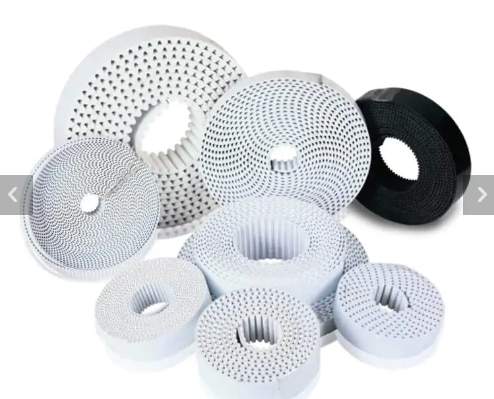 | PU Timing Belts has high performance transmission. This PU Belts has high intensive and low extension adoptive modules. View product → |
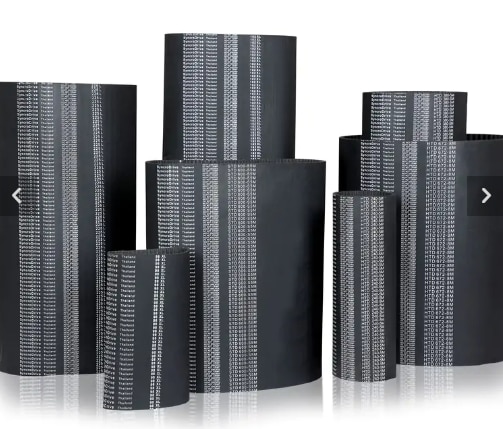 | Rubber Timing Belts Timing belts make less noise compare to chain belts and gear belts and has high transmission capacity and efficiency. View product → |
Frequently asked questions
What drive data should you send to timing belt dealers in Mumbai?
Send the belt marking, tooth profile, pitch, width, tooth count or length, pulley tooth counts, centre distance, speed, transmitted power, operating temperature and exposure to oil or chemicals.
How do you choose the correct industrial timing belt construction?
Match the tooth geometry and pitch first, then choose rubber or polyurethane construction, tensile cord and tooth-facing material for the load, speed, temperature and operating environment.
What should you inspect on timing belt pulleys before replacement?
Check tooth wear, chipped or hooked teeth, flange damage, pulley runout, shaft alignment, bearing play and contamination. Replace a pulley that cannot support full tooth engagement.
How should you install and test a replacement timing belt?
Align the pulleys, fit the belt without prying, set tension to the belt maker's specification, rotate the drive by hand, install guards and run a controlled test while checking tracking, noise and temperature.
How can you compare timing belt dealers in Mumbai?
Compare their ability to verify the belt profile and application, provide traceable product information, confirm stock or lead time, and support installation and replacement decisions.
Related product
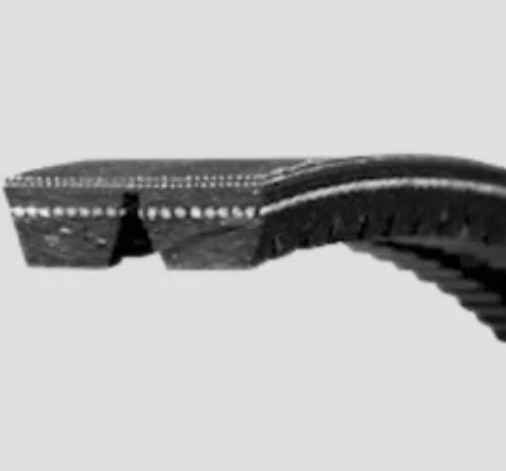 | Rubber Banded Belts Rubber Banded Belts are made up from Classical, Wedge or Narrow belts with strong tie band over them. View product → |