A belt can fail even when room temperature and the chemical label appear to be within a published range. By measuring the belt’s real operating conditions, identifying the attack mechanism, and specifying the complete belt construction, you can separate a material problem from an installation or maintenance problem.
Key takeaways
- Locate heat sources before choosing heat resistant industrial belts.
- Match the belt compound to the chemical, concentration, temperature, and exposure time.
- Inspect teeth, adhesive layers, and coatings—not only the belt surface.
- Replace the complete belt construction when heat or chemicals damage its layers.
How heat changes a belt before it breaks
Heat changes a belt long before it snaps: elastomers soften or harden, glaze from friction, crack through oxidation and repeated flexing, and lose tensile and fatigue life. Adhesive layers can delaminate; timing-belt teeth deform, reducing tooth engagement even when the belt still appears intact.
1. Measure the belt, not just the room. Record continuous operating temperature, short-duration peak temperature, exposure time, and belt-surface temperature during the real duty cycle. Hot solids and the belt cover can have different temperatures: a thick product bed holds heat, while a thin layer can create thermal shock.
2. Find local heat sources. Check slip from low tension or insufficient wrap, misalignment, undersized pulleys, pulley flexing, seized bearings, overload, enclosed machinery, trapped product, and hot splices. A room-temperature reading will miss a hot pulley, tooth flank, splice, or loaded section.
3. Compare the damage with the location. Glazing and softening point to friction; hardening, cracking, and delamination point to thermal ageing; tooth deformation points to heat combined with load. Industrial belts failing from heat and chemicals can lose friction, adhesion, dimensional stability, and fatigue life before visible breakage.
4. Treat “heat resistant industrial belts” as a complete-construction claim. Ask for continuous and peak limits covering the cover, fabric, cords, adhesive, teeth, and splice—not the cover compound alone. A belt rated for hot ambient air can still fail when slip, overload, or trapped product raises its surface temperature.
Find the heat source before replacing the belt
Measure the drive before replacing the belt: temperature patterns tell you whether heat caused industrial belt failure or exposed a drive fault. Compare the belt surface across its width and at each pulley; a local peak points to slip, geometry, or a bearing problem, while broad elevation supports thermal exposure.
Do not select heat resistant industrial belts until the source is corrected.
Heat accelerates ageing through oxygen, dwell time at temperature, and repeated flexing. Local hot spots consume fatigue life quickly, even while the belt looks intact. Preserve the failed belt, and record temperature, chemical identity and concentration, speed, tension, pulley or sprocket dimensions, alignment, cleaning regime, and failure location before disposal.
- Check slip marks and glazing; polished rubber and dust indicate slipping.
- Verify tension and wrap angle; low values raise slip heat.
- Inspect alignment, pulley or sprocket dimensions, and flexing for local edge heat.
- Test bearings for roughness, drag, and abnormal temperature.
- Confirm load and speed against the belt specification, including overloads and enclosed duty.
| Clue | Likely direction | Check |
|---|---|---|
| Damage at one pulley | Local heating or geometry | Compare pulley temperatures; inspect dimensions, alignment, and bearing |
| Splice-only damage | Bonding or washdown stress | Check splice design, cleaner, pressure, temperature, and rinse |
| Uniform cracking | Broad thermal ageing | Compare full-width temperature and exposure time |
Match the belt compound to the chemical and exposure
Choose a chemical resistant belt only after matching the compound to the chemical and the duty. Record the chemical name, concentration, temperature, exposure time, and mechanical load for oils, fuels, solvents, acids, alkalis, coolants, detergents, and process chemicals. A generic resistance label cannot predict every industrial belt failure.
| Exposure mode | What it reaches | What to check |
|---|---|---|
| Splash | The cover and exposed edges | Droplet temperature, concentration, frequency, and drainage |
| Vapour | Cover, fabric, adhesive, and cord interfaces | Vapour temperature, dwell time, and condensation |
| Immersion | The full belt surface and seams | Continuous immersion time, swelling, and tensile-load retention |
| Washdown | Cover, splice, fabric, and reinforcement interfaces | Pressure, temperature, concentration, contact time, and rinse procedure |
| Continuous contact | The loaded cover and contact surfaces | Chemical temperature, pressure, friction, and exposure duration |
Nitrile rubber suits mineral oils and many petroleum fluids, but it does not resist every chemical or solvent. EPDM is a stronger candidate for hot water, steam, dilute acids, and dilute alkalis; petroleum oils and fuels can cause it to swell or fail.
Compatibility tables are screening tools, not guarantees. Higher temperature speeds diffusion and swelling, while mixed chemicals can behave differently from individual test results. Treat a hot caustic washdown as a separate compatibility case, especially when pressure drives liquid into a splice or cord interface.
Record the rinse method too: residue left on the belt can extend chemical contact after cleaning.
What heat and chemicals do to polyurethane and PTFE-coated belts
A polyurethane teflon belt can fail while its tensile strength still looks acceptable. Swelling, softening, surface tack, brittle sections, cracking, blistering, delamination, cord pull-out, tooth deformation, tracking changes, unexplained elongation, and slip all indicate that the compound or an interface has changed; “polyurethane” alone does not identify the construction.
Inspect these service clues:
- A timing belt with damaged tooth flanks, pitch change, exposed cords, or a failed splice has lost more than surface appearance.
- Ester polyurethane is vulnerable to hydrolysis in hot, humid, or wet service.
- Ether polyurethane generally resists hydrolysis better, but it has different limits for oil exposure, abrasion, and mechanical loading.
- A “Teflon belt” normally means PTFE-coated fabric, not solid PTFE. The coating may resist chemicals while the base fabric, adhesive, seam, cords, clamps, or splice creep, expand, or lose adhesion.
- PTFE’s polymer capability near 260 °C does not rate the assembled belt. Speed, tension, load, adhesive, fabric, and seam set the practical limit.
| Material | What helps | What can still fail |
|---|---|---|
| Ester polyurethane | Oil and solvent resistance | Hydrolysis, swelling, softening, tooth loss |
| Ether polyurethane | Better hot-water and humidity resistance | Different oil, abrasion, and mechanical limits |
| PTFE-coated fabric | Low friction and broad chemical resistance | Fabric, adhesive, seams, cords, clamps, and splice creep or delamination |
A chemical resistant belt is therefore a construction, not a material name. Check the tooth profile and pitch separately from cord adhesion, and treat slip or tracking change as evidence of dimensional or friction loss even when the belt appears intact.
Specify, test, and replace the complete belt construction
Select a replacement only after matching measured duty conditions to the complete construction and preserving the failed belt for confirmation of the industrial belt failure. For conveyors, map belt-surface temperature during loading, conveying, discharge, and cleaning; hot product temperature does not equal cover temperature.
Ask the supplier for:
- Continuous and peak temperature limits for the full belt construction
- Chemical compatibility at the actual concentration and temperature, including exposure classification
- Speed and load limits, plus pulley or sprocket requirements
- Cord material, fabric, adhesive or splice design, and cleaning instructions
ISO 4195 heat categories do not define product temperature, cover temperature, speed, cover thickness, or service life by themselves. A table cannot represent mixed chemicals or combined heat and moisture; run a controlled trial instead.
| Failure clue | What to verify | Likely decision |
|---|---|---|
| One pulley or sprocket | Local temperature, dimensions, alignment, bearings | Correct geometry or heat source |
| Splice only | Adhesive, splice design, washdown and tension | Change construction or joining method |
| Uniform cracking | Broad thermal exposure and dwell time | Reassess compound and duty rating |
Record batch, installation date, tension, alignment, cleaning regime, temperature map, and failure location. Jigna Sales Corporation can help compare rubber, polyurethane, timing, and coated-belt constructions against those measurements, rather than relying on “heat resistant industrial belts” or “chemical resistant belt” labels.
Related product
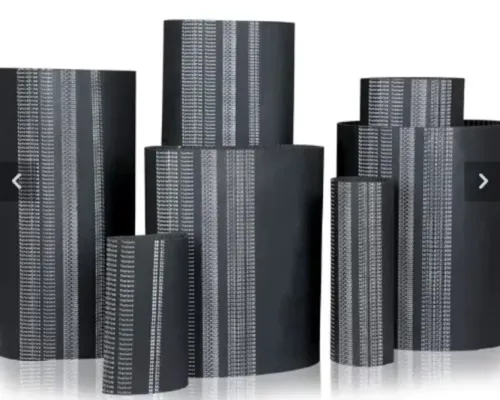
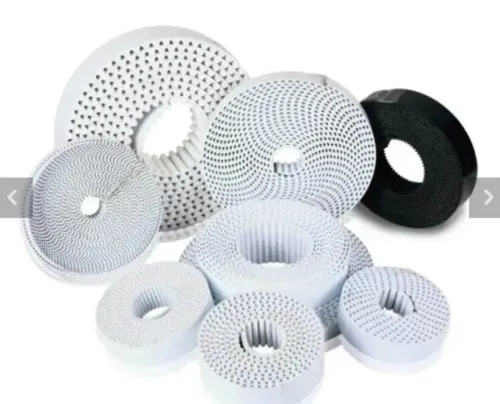
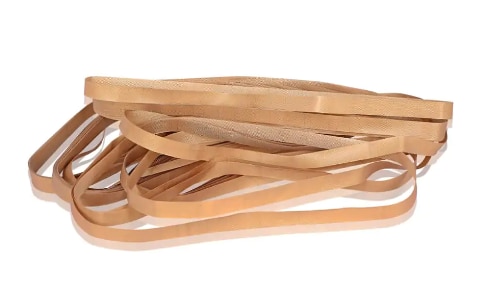 | Polyurethane Teflon Belt PU cord /Teflon belt has High Modulus Polyurethane compound which resists ozone and weather condition, having strength of smooth drives with high... View product → |
Frequently asked questions
How does heat damage an industrial belt before it breaks?
Heat can soften or harden elastomers, create friction glazing, accelerate oxidation and flex cracks, reduce tensile and fatigue life, and deform timing-belt teeth.
How can you find the heat source causing industrial belt failure?
Inspect contact points, pulley alignment, guarding, ventilation, bearing condition, slippage, tension, and nearby heaters before installing a replacement.
How do you choose a chemical resistant belt?
Match the belt compound to the named chemical, concentration, temperature, contact duration, and exposure pattern, then confirm compatibility with the manufacturer.
What problems affect polyurethane and PTFE-coated belts?
Polyurethane can lose performance when exposed to unsuitable heat or chemicals, while PTFE-coated constructions require attention to coating damage, adhesion, and the belt layers beneath the coating.