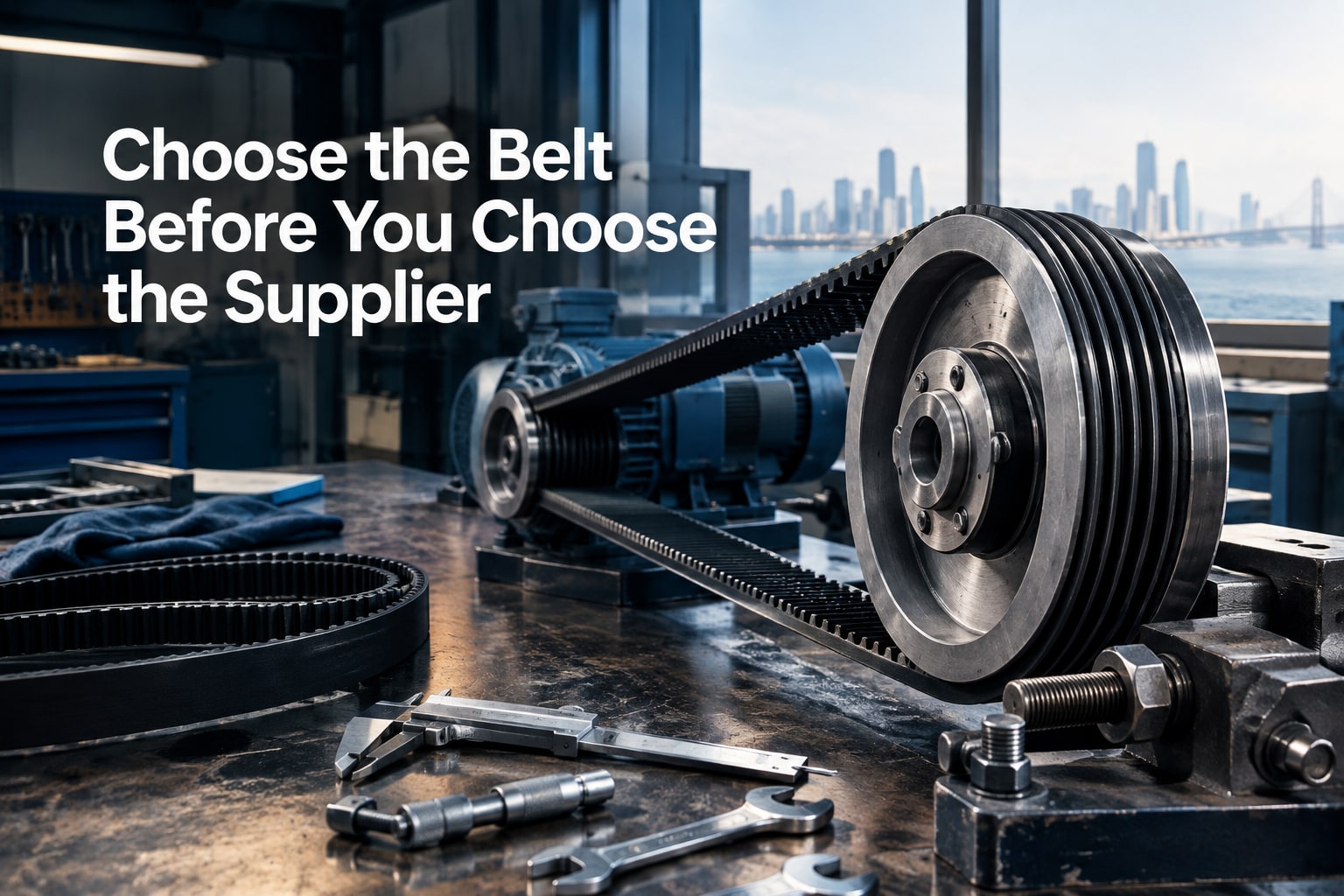
A high-speed belt drive can fail because the belt section, effective length, sheave groove, tension, or balance is wrong even when the printed belt size looks correct. By the end, you will be able to compare suppliers, identify the right belt system, verify its speed rating, and send enough machine data for a defensible quotation.
Key takeaways
- Choose the belt profile and section before comparing Mumbai suppliers.
- Measure sheave diameters, centre distance, and belt length as one drive.
- Check rated speed, tension, worn sheaves, oil, heat, and debris.
- Demand a quotation listing belt construction, dimensions, rating, and support.
Choose the belt construction before you compare suppliers
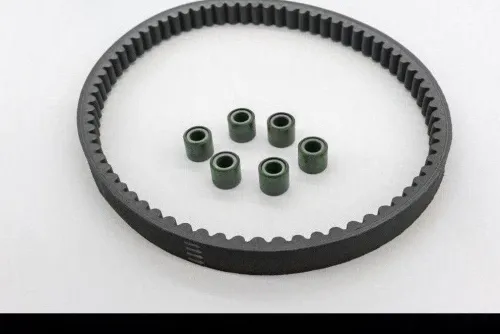
For a high-speed drive, select the exact profile, section, sheave diameter, and rated speed before comparing cogged v belt manufacturers. A cogged V-belt suits smaller sheaves because molded notches improve flexibility, reduce bending loss, and help limit heat buildup. It remains a friction drive: it can slip and cannot provide timing accuracy.
| Construction | Flexibility and heat | Noise, contamination, service life |
|---|---|---|
| Cogged or notched V-belt | More flexible; lower bending loss around small sheaves; improved heat control at speed | Usually noisier and less tolerant of debris in exposed notches; service life depends heavily on tension and environment |
| Wrapped V-belt | Stiffer; higher bending loss on small sheaves; can run hotter when flexed repeatedly | Quieter and generally better protected from dust and light contamination; often lasts longer on compatible sheaves |
| Drive type | Power and pulley arrangement | Correct choice and wrong-pulley consequence |
|---|---|---|
| Classical industrial V belt or industrial vee belts | Moderate power density; standard grooved sheaves | Use the matching section; a wrong groove causes slip, wear, and overheating |
| Narrow or wedge belt | Higher power density in a narrower section; matching deep-groove sheaves | Do not fit it into a classical groove |
| Poly-V belt | Multiple ribs on one pulley; high speed and compact routing | A V-belt pulley will not seat or transmit power correctly |
| Timing belt | Toothed belt and pulley; positive synchronization | Choose it for indexed motion; a V-belt cannot hold timing |
Choose a timing belt for synchronized shafts. In food processing, specify construction approved for the hygiene and cleaning regime, not a generic rubber belt. Reject a cogged belt when the existing pulley profile cannot accept its notched construction. Compare supplier offers by exact designation and section, never by “high-speed” claims or nominal width alone.
Identify the belt section and measure the complete drive
Remove one belt from the drive before measuring it; never stretch it around a rule. Photograph every moulded marking, then record the belt’s top width, thickness, inside length, outside length, and pitch or datum length. Ask the supplier which length convention the quotation uses.
- Measure each sheave’s effective or pitch diameter, not only its outside diameter.
- Record groove angle, groove depth, number of grooves, groove spacing, and visible wear.
- Record centre distance, shaft arrangement, and the belt’s wrap angle.
- Compare the proposed replacement against the existing belt section and groove geometry before ordering.
| Section system | What it identifies | Interchange warning |
|---|---|---|
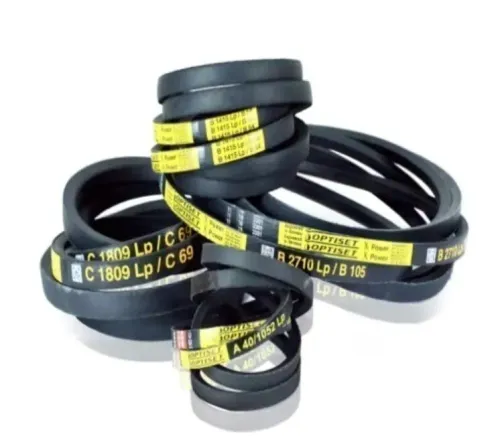
| Classical A, B, C, D | Traditional industrial V belt sections with progressively larger cross-sections | Do not substitute for narrow sections by nominal width |
| Narrow 3V, 5V, 8V | American wedge-belt sections designed for higher power density | A similar-looking classical belt can sit incorrectly in the groove |
| Metric SPZ, SPA, SPB, SPC | Metric wedge sections, increasing from SPZ to SPC | Similar nominal dimensions do not make them interchangeable with 3V, 5V, or 8V |
A measured outside circumference alone can select the wrong effective length, especially with cogged or raw-edge industrial vee belts. Confirm whether the supplier specifies inside, datum, or outside length, and match the replacement to the measured pulley profile rather than its printed size.
That check matters more than a generic claim about industrial V belt performance.
Check speed, tension, sheave condition, and contamination
At 3,000 rpm, a sheave with a 200 mm pitch diameter produces belt speed of approximately 31.4 m/s: metres per second = π × pitch diameter in metres × rpm ÷ 60. Use effective or pitch diameter, not outside diameter; the wrong diameter understates speed and distorts wrap and power calculations.
Require the supplier’s maximum permissible speed for the exact industrial V belt section, construction, small-sheave diameter, and service. Excessive speed increases heat, vibration, tension sensitivity, and wear. Excessive initial tension loads shafts and bearings; insufficient tension causes slip, glazing, heat, and short belt life.
Specify a repeatable tension method and its measurement condition: frequency, force/deflection, or a supplier-approved gauge, measured before start-up, after bedding, or at the stated operating temperature. Check the drive before accepting the belt:
- Verify sheave concentricity and balance; an eccentric or unbalanced sheave creates running-speed vibration that replacing the belt will not cure.
- Inspect groove wear, groove profile, angular alignment, and parallel alignment. Misalignment causes tracking faults, sidewall wear, heat, and edge failure.
- Record oil, dust, washdown, ozone, and temperature exposure.
- Ask whether the compound is oil-resistant, heat-resistant, ozone-resistant, electrically conductive, or flame-retardant for that exposure.
- Request the electrical-conductivity classification and test basis in hazardous or dust-sensitive areas.
Antistatic, conductive, flame-retardant, and oil-resistant are different properties. Do not treat one as proof of another.
Demand a technical quotation from Mumbai suppliers
A technically accountable supplier gives you a traceable selection, not a relabelled stock item with a horsepower claim. Send the following information before comparing cogged V-belt manufacturers or V-belt manufacturers in Mumbai:
1. Provide the machine type, motor power, driver and driven sheave diameters, rpm, centre distance, belt section, number of belts, rotation, duty cycle, start-up conditions, ambient temperature, oil or chemical exposure, dust, washdown, and food-contact constraints.
2. Demand a technical datasheet and quotation stating the exact profile designation, inside, datum, or outside length convention, belt construction and compound, operating-temperature range, minimum recommended sheave diameter, permissible belt speed, and power-rating basis. The power rating must account for section, speed, small-sheave diameter, wrap angle, centre distance, belt length, and service factor.
3. Ask for the production batch number and conformity documentation, such as the applicable standard declaration or certificate. A supplier that cannot identify the batch or explain the document is not offering useful traceability.
4. For parallel belts, request a matched set or supplier-approved matched-length system; never mix belts carrying the same printed size. Ask for the tensioning method, alignment procedure, groove inspection requirements, and evidence of sheave balance or concentricity.
Jigna Sales Corporation belongs in the comparison only if it supplies these details for the proposed drive. A lower price cannot offset an unverified section, speed limit, length convention, or sheave condition.
Use installation and support as part of the buying decision
A recommendation earns trust only when the supplier supplies commissioning and maintenance instructions, not just a belt size. Store belts away from direct sunlight, ozone-producing electrical equipment, oil, chemicals, excessive heat, and sharp kinks; do not hang them long-term if the hanger permanently deforms them.
Fit the belt without levering it over a pulley, because forced installation can damage cords and cause later vibration or cracking.
| Support item | Evidence to request | Failure it helps prevent |
|---|---|---|
| Storage and fitting | Written storage limits, fitting method, and replacement procedure | Premature cracking or cord damage |
| Sheave condition | Groove inspection criteria and replacement limits | Tracking, edge wear, and mismatch |
| Tension and alignment | Frequency, force/deflection, or approved-gauge method covering angular and parallel alignment | Slip, heat, bearing load, and vibration |
| Troubleshooting | Batch traceability, replacement continuity, warranty evidence, and help checking balance or overload | Repeated belt changes without correcting the drive |
Before fitting, inspect every groove and replace worn or mismatched sheaves. Align shafts for both angular and parallel error. After commissioning, record running speed, measured tension, temperature, vibration, slip, and edge wear, then recheck tension after the manufacturer’s specified bedding period.
- Ask V-belt manufacturers in Mumbai to state how replacement belts will match the production batch and exact section.
- Investigate vibration at running speed before replacing belts again; an eccentric or unbalanced sheave, or an overloaded drive, can be the real fault.
- Treat installation support as part of the quotation when selecting industrial vee belts.
Frequently asked questions
Why choose a cogged V-belt for a high-speed drive?
Molded notches improve flexibility around smaller sheaves, reduce bending loss, and help control heat buildup. The belt remains a friction drive, so it can slip and cannot provide timing accuracy.
What should you measure before ordering an industrial V-belt?
Identify the belt section, then record the sheave diameters, groove condition, centre distance, shaft arrangement, rotation, and required belt length.
What operating conditions should you check before selecting a cogged V-belt?
Check the drive speed, belt tension, sheave wear, alignment, temperature, oil exposure, dust, and other contamination before requesting a replacement.
What should a technical quotation from Mumbai V-belt manufacturers include?
Request the belt profile, section, construction, length, rated speed, compatible sheave dimensions, quantity, delivery details, and installation or replacement support.