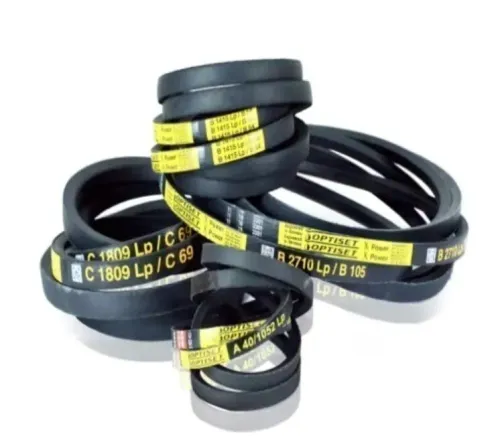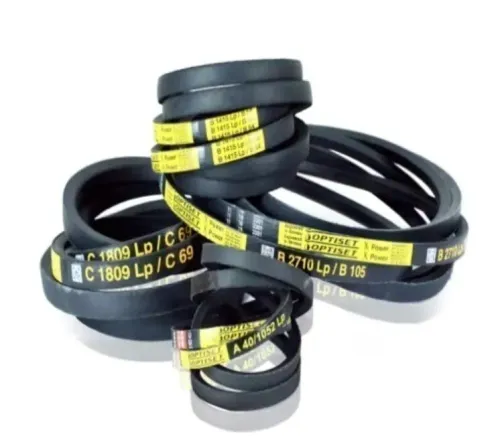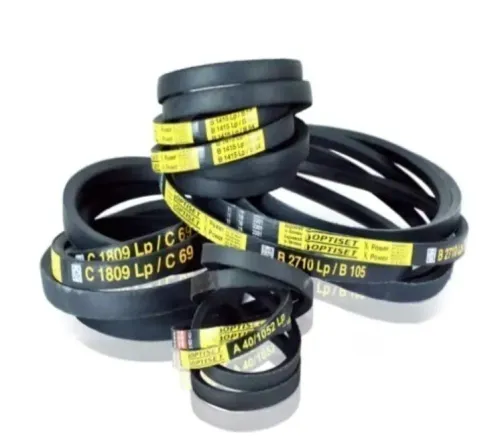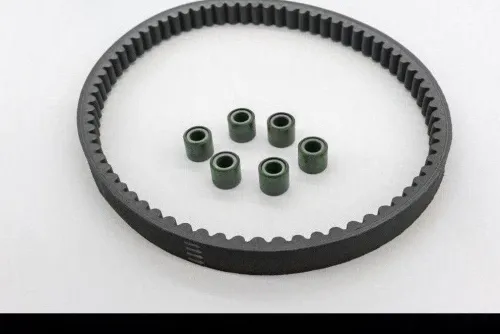
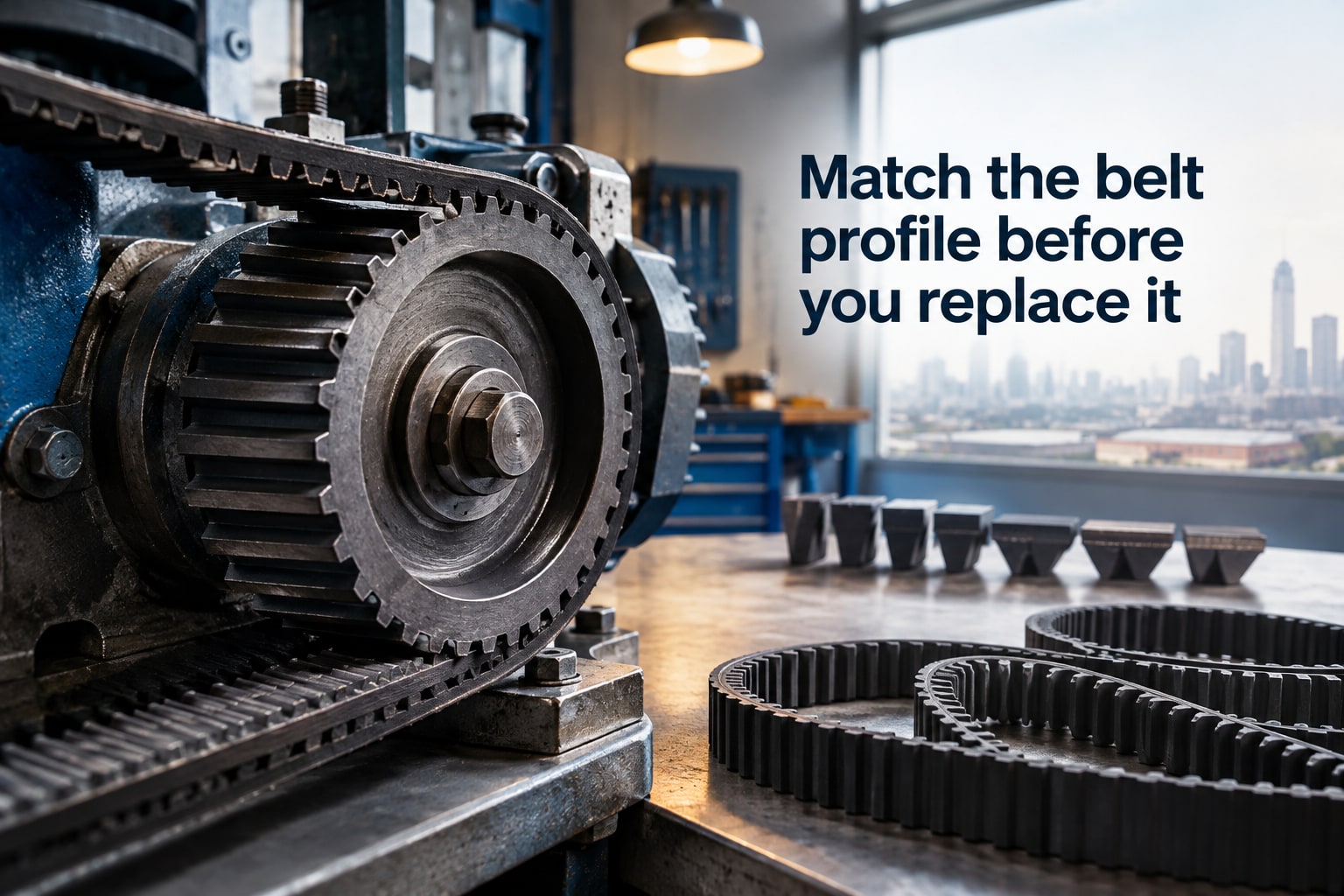
“Industrial timing belt” names an application category, not a material that automatically differs from a rubber timing belt. You will be able to compare rubber and polyurethane constructions, identify the correct profile and replacement code, size the drive from its operating data, and install and inspect the belt without creating a preventable failure.
Key takeaways
- Treat industrial timing belts as a category that includes rubber and polyurethane belts.
- Match tooth profile, pitch, width, length, pulley teeth and flange details before ordering.
- Use the belt’s printed code, tooth count and dimensions to verify a replacement.
- Set tension with the manufacturer’s method; never lever a belt onto the pulleys.
What “industrial timing belt” means beside a rubber timing belt
“Industrial timing belt” is a synchronous power-transmission category, not a product type opposed to rubber timing belts. It includes rubber or chloroprene belts and polyurethane belts. Conventional rubber construction combines an elastomer body, fiberglass tensile cords and nylon tooth-facing fabric.
| Feature | Rubber timing belt | Polyurethane timing belt |
|---|---|---|
| Tooth profile and pitch | Trapezoidal or HTD profiles; pitch and width vary by series | Trapezoidal or curvilinear profiles; pitch and width remain series-specific |
| Cord and facing | Fiberglass cords with nylon tooth fabric | Steel, aramid or fiberglass cords with polyurethane tooth material |
| Resistance | Good damping; moderate abrasion and selected oil resistance | Better abrasion, cutting and selected oil resistance; chemical compatibility is compound-specific |
| Temperature examples | Many general-purpose catalogs list about −30°C to +100°C | Many general-purpose catalogs list about −30°C to +80°C |
| Speed and load | Capacity depends on cord design, tooth geometry, wrap angle and width | Capacity depends on the same factors; a material label alone is not a rating |
A rubber belt and polyurethane belt with identical nominal pitch and length still cannot be exchanged. Match pulley tooth geometry, cord line, width and manufacturing tolerances, or tooth engagement and tracking can fail.
Molded endless rubber belts suit clean, repeatable drives; open-ended or joined polyurethane belts suit fixed shafts and long centres, but joints limit strength, shock resistance and precision. Polyurethane also demands application-specific alignment, chemical and temperature checks.
How to match the timing-belt profile and drive dimensions
Select the belt profile before comparing brands or materials. Pitch is the tooth-to-tooth spacing; pitch length equals pitch multiplied by tooth count. Profiles are not interchangeable because tooth depth, flank shape and pulley-groove geometry differ.
| Profile | Family | Common designations |
|---|---|---|
| Trapezoidal imperial | Inch | MXL, XL, L, H, XH |
| Trapezoidal metric | Metric | T5, T10, AT5, AT10 |
| Curvilinear HTD | Metric | 3M, 5M, 8M, 14M |
Trapezoidal teeth suit their matching pulley forms; AT versions have stronger tooth geometry than comparable T profiles. HTD curvilinear teeth distribute load differently and require HTD pulleys. Do not fit a 5M belt to a T5 pulley.
For a complete specification, provide:
- Pulley tooth counts, speed ratio, pulley width and centre distance
- Required belt length, shaft speed, transmitted motor power or torque and service factor
- Wrap angle, duty cycle, operating environment and allowable tooth-shear load
A wider belt cannot correct too few teeth on the small pulley, inadequate wrap or excessive tooth shear. Those conditions cause tooth jump even when a belt does not slip.
Industrial timing belts provide synchronous transmission: teeth engage pulley grooves and maintain phase. V-belts, cogged V-belts, poly-V belts and rubber-banded belts rely on wedging or surface contact and can slip.
For timing belts India applications, check Mumbai heat, humidity, coastal corrosion, oil, diesel, cutting fluid, solvents and cleaning chemicals. Confirm compound-specific compatibility and both continuous and peak temperature limits before approval.
How to identify the right replacement belt from its markings
A replacement starts with evidence, not a guessed brand. Photograph every printed marking before removing the belt, then record the pitch designation, tooth profile, pitch length or length code, width code, tooth count and manufacturer part number.
| Marking | Physical verification | Why it matters |
|---|---|---|
| Pitch/profile | Count teeth and identify pulley tooth form | Confirms geometry |
| Length code | Measure pitch length or calculate pitch × tooth count | Exposes partial or wrong labels |
| Width code | Measure belt width with calipers | Prevents incorrect load capacity |
| Part number | Match the complete code to the drawing | Avoids look-alike substitutions |
Write the procurement request with the complete code and quantity, plus material, critical tensile-cord type, operating speed, torque or motor power, pulley tooth counts, centre distance and environment.
For an alternate source, request a dimensional drawing and manufacturer load-rating table. Identical pitch does not prove equal length tolerance, cord line, load rating or pulley compatibility; compare the belt and pulleys as a matched system.
Inspect retained pulleys for hooked or polished tooth flanks, burrs, corrosion, eccentricity, damaged flanges and incorrect profile. Do not fit a new belt onto worn pulleys.
| Failure pattern | Likely clue |
|---|---|
| Tooth shear | Overload, insufficient wrap or wrong profile |
| One-sided wear or frayed edges | Misalignment or flange trouble |
| Cracks and hardening | Heat, ozone or age |
| Exposed cords | Chemical, tensioning or installation damage |
Use these checks when comparing rubber timing belt manufacturers in India or a timing belt manufacturer in India.
How to install and tension a synchronous belt without damaging it
Fit rubber timing belts and other industrial timing belts without forcing them over the pulleys; forced installation can damage tensile cords before the drive runs.
1. Set the shafts parallel and align the pulley faces. Release the tensioner or reduce the centre distance so the belt drops over both pulleys. Never pry it over a flange with a screwdriver or lever; internal cord damage can create a later failure.
2. Confirm that each flange sits in the belt series’ manufacturer-specified position. Remove corrosion and burrs from pulleys, flanges and exposed shafts before fitting the belt.
3. Set static tension using the belt series’ specified force-and-deflection method, frequency method or tension instrument. Do not copy the hand feel of another belt.
4. Rotate the drive manually through several revolutions, then verify tension again. The belt should track centrally without touching either flange.
5. Install the guard before operation. Keep hands, clothing and tools away from the rotating drive.
Excessive tension overloads shaft bearings and accelerates belt and pulley wear. Insufficient tension causes tooth jumping; jumping also indicates excessive torque, inadequate pulley wrap, too few small-pulley teeth, eccentricity or a seized driven machine.
Edge wear points to shaft or pulley misalignment, flange contact or corrosion burrs. In Mumbai, store belts cool, dry and shaded, away from ozone-generating electrical equipment, heat and humidity. Inspect storage and installation areas before commissioning.
How Mumbai buyers should compare suppliers and approve a belt
Approve a belt only after the supplier proves dimensional and application equivalence; identical pitch does not prove matching tooth profile, cord line, length tolerance, load rating or pulley compatibility.
| Option | Better fit | Check before approval |
|---|---|---|
| Rubber | General industrial drives needing molded endless construction and damping | Compound, temperature and oil resistance |
| Polyurethane | Abrasion, cutting, selected oil exposure, open-ended supply or long centre distance | Alignment, joint strength, chemical limits and peak temperature |
Ask for:
- Complete profile and pitch, tooth count or pitch length, width, material and exact compound, tensile-cord construction, allowable speed, rated power or torque, continuous and peak temperature, oil and chemical compatibility, joint status, pulley tooth counts and widths, quantity, warranty terms, and a dimensional drawing.
- A sample belt code, manufacturer load-rating table and equivalent-code check. Request confirmation against the actual pulley profile, centre distance and shaft speeds.
- Separate compatibility answers for humidity, oil, diesel, cutting fluid, solvent and steam-cleaning exposure. Humidity does not prove resistance to any of them.
- Replacement-belt traceability for a high-value or high-duty drive, and an inspection of pulley teeth, flanges, corrosion, wear and eccentricity before approval.
Jigna Sales Corporation, a Mumbai-based supplier, dealer, importer and exporter, can review rubber and polyurethane specifications when you provide complete drive data rather than asking for only “an industrial timing belt.” This is the comparison expected from rubber timing belt manufacturers in india, a timing belt manufacturer in india, and suppliers serving timing belts india.
Related products
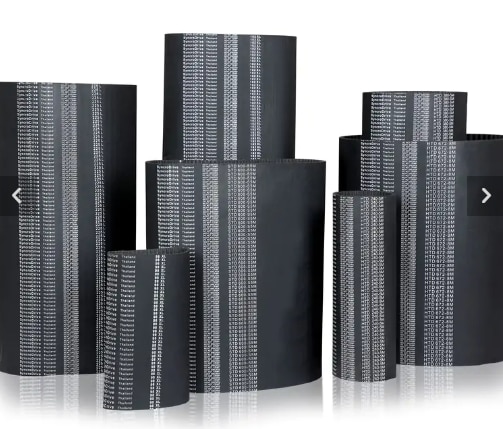 | Rubber Timing Belts Timing belts make less noise compare to chain belts and gear belts and has high transmission capacity and efficiency. View product → |
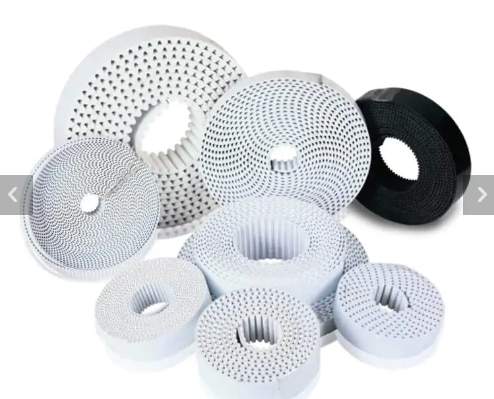 | PU Timing Belts has high performance transmission. This PU Belts has high intensive and low extension adoptive modules. View product → |
Frequently asked questions
What does “industrial timing belt” mean beside a rubber timing belt?
Industrial timing belt describes the synchronous power-transmission category. Rubber or chloroprene belts and polyurethane belts belong to this category; conventional rubber belts use an elastomer body, fiberglass tensile cords and nylon tooth-facing fabric.
How do I match a timing-belt profile and drive dimensions?
Confirm the tooth profile, pitch, belt width, tooth count or pitch length, pulley tooth counts and pulley bore before ordering. A belt with the wrong pitch or profile will not mesh correctly even when its width appears suitable.
How can I identify the right replacement belt from its markings?
Read the complete printed code, then verify its profile, pitch, width and length against the existing belt and the machine manual. Count teeth and measure the belt when markings are worn or incomplete.
How do I install and tension a synchronous belt without damaging it?
Align the pulleys, loosen the adjustable centre distance, fit the belt without twisting or levering it, and apply the specified tension using the manufacturer’s method. Check alignment and rotate the drive by hand before running it.
How should Mumbai buyers compare timing-belt suppliers and approve a belt?
Compare the supplier’s technical match, stock condition, traceable markings, delivery terms and replacement support. Ask for a clear quotation showing profile, pitch, width, length, quantity and warranty terms before approval.